9 Days

Easy

3,210m

Nepal

2-16

Hotel


B, L, D
Explore more facts about the trip
US$ 799
The Poon Hill Trek is a short, yet rewarding journey into the Annapurna region; some stunning panoramas of the Himalayas have been thrown in. This is an excellent schedule for travelers of any age looking to experience Nepal’s mountain beauty without having to stress themselves on a more challenging trek. With just a few days in hand, revel in both nature’s beauty and rich cultural diversity.
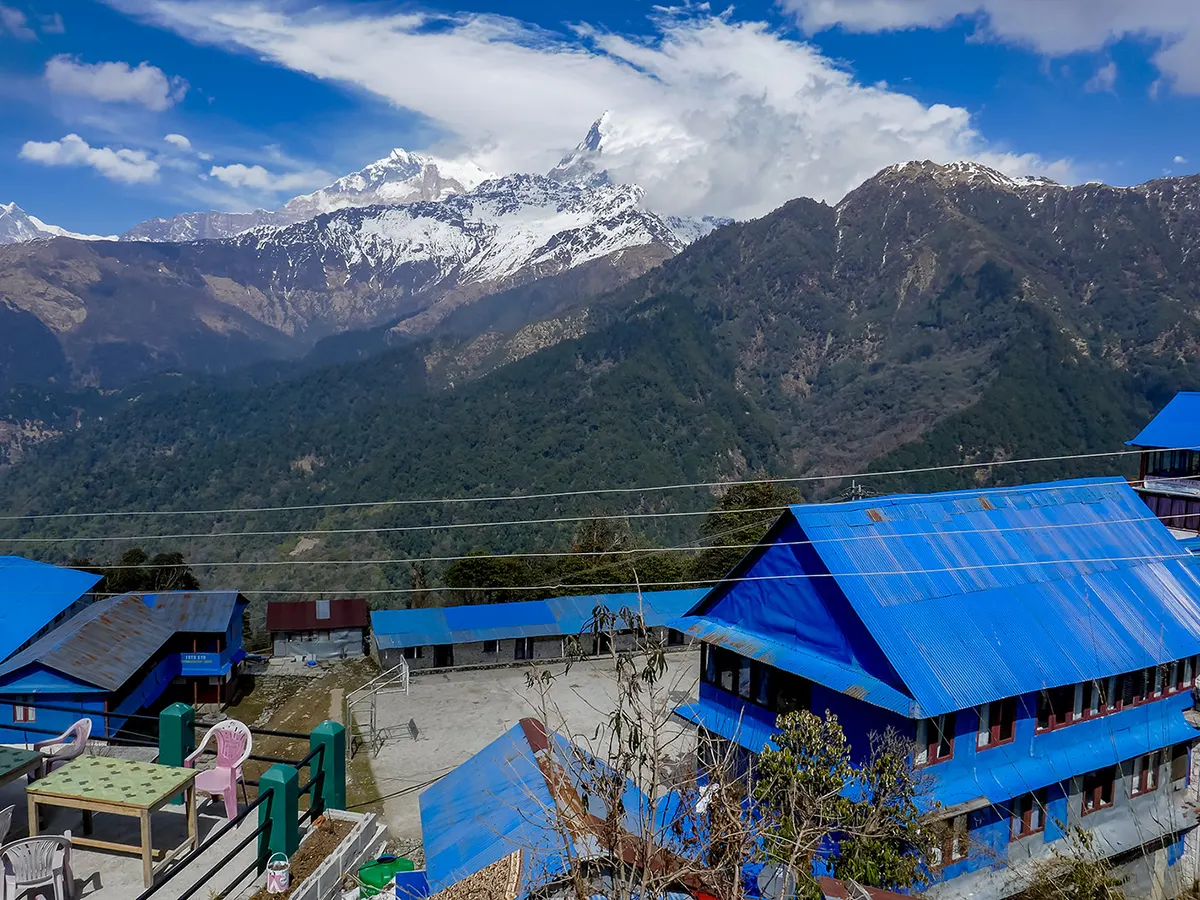
Watch sunrise from the top of Poon Hill, which stands at 3,210 meters above sea level, and a view of the first rays of the sun touching peaks such as Dhaulagiri, Annapurna, and Machhapuchhre form part of the highlights of the Poon Hill Trek.
This is an ideal trek for nature lovers, with the sight of these majestic mountains combined with the peace in the atmosphere. The trek also offers glimpses of the local life as you trek through villages where the Gurung and Magar communities reside.
This trek is perfect for a limited time or one seeking an easy trek. The Poon Hill Trek starts from Birethaiti, via Ghorepani to Ghandruk offering varied landscapes from dense jungles to terraced fields. You will be accommodated in teahouses where locals welcome you with a share of Nepalese hospitality and food.
From mountain vistas and cultural experiences to peaceful treks into nature, Poon Hill has it all. This is then followed by an exciting combination of the beauty of the Annapurna region combined with the warmth in local traditions, making it one of Nepal’s most beloved trekking destinations.
Your arrival in Kathmandu starts the first day of the Poon Hill Trek. Once you arrive, our company staff will greet you warmly at the airport. Immediately after a short introduction, you will be transferred to your hotel for check-in and to get your luggage settled. Thus, your exciting trek itinerary begins here.
Take your time to get comfortable in the hotel. If you feel up for it, take a stroll to Thamel, the tourist hub of Nepal. This is a great area to do some last-minute shopping for the Poon Hill Trek or simply enjoy the local cafes and clubs.
You will come back to your hotel this evening for some rest and preparation for the journey ahead. The first-day Poon Hill Trek will get you accustomed to the surroundings and get you ready for the adventure awaiting in the Annapurna region.

The second day of Poon Hill Trek involves a picturesque 6- to 7-hour drive from Kathmandu to Pokhara, which covers the distance of 204.8 km.
The drive takes you on winding roads, full of sights of Nepal’s varied landscapes: terrace fields, forests and faraway peaks of the Himalayas. This drive gives a feel of the rural Nepalese way of life while it takes one through small villages and riverside towns.
The Poon Hill Trek offers time- and effort-saving alternatives: a 30-minute flight from Kathmandu to Pokhara.
Aside from shortening the itinerary, flying actually provides a view of Nepal’s nature from a bird’s perspective—an amazing blend of majestic mountains mingled with verdant valleys. The cost is roughly about $120, and the advantage of this flight is that you can reach Ulleri the same day, therefore making your trek more efficient.
Your arrival in Pokhara via the scenic drive or the quick flight begins the Poon Hill Trek. Pokhara which is one of the beautiful gateway cities to the Annapurna region lies along serene Phewa Lake and presents a peaceful atmosphere prior to the start of the trek.
On the third day of the Poon Hill Trek, we will drive from Pokhara to Birethanti. This drive will take around 1 hour 30 minutes. Today’s drive will be scenic with beautiful green hills and rivers. We will drive through the small villages until we reach Birethanti which is ahead of the bridge from Nayapul.
We begin our trek to Ulleri from Birethanti, passing by villages like Matathanti and Lamdawali. The trail then passes through typical Nepalese villages, where lodges and resting places will be available. On the way to Poon Hill Trek, the route is filled with greenery and peaceful rural surroundings.
As we walk uphill, we will pass Hile and Tikhedhunga before facing the toughest section of the day. From here, we will walk 3,500 stone steps, which go upwards with an ascent of 500 meters. The exhausting steps will take us to the village of Ulleri, perched at an elevation of 2,050 meters after five hours of trekking.
We will stay overnight here at Ulleri on our third day of the Poon Hill Trek.
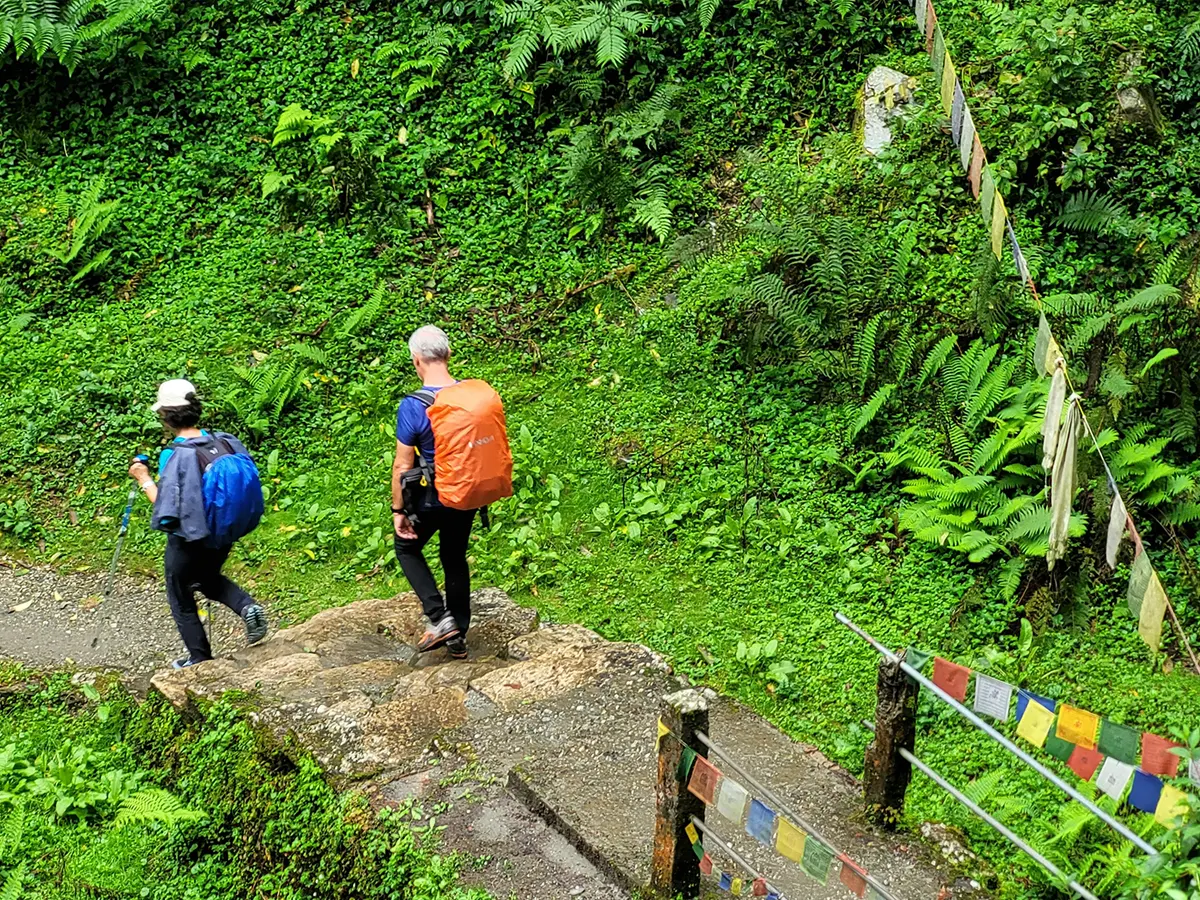
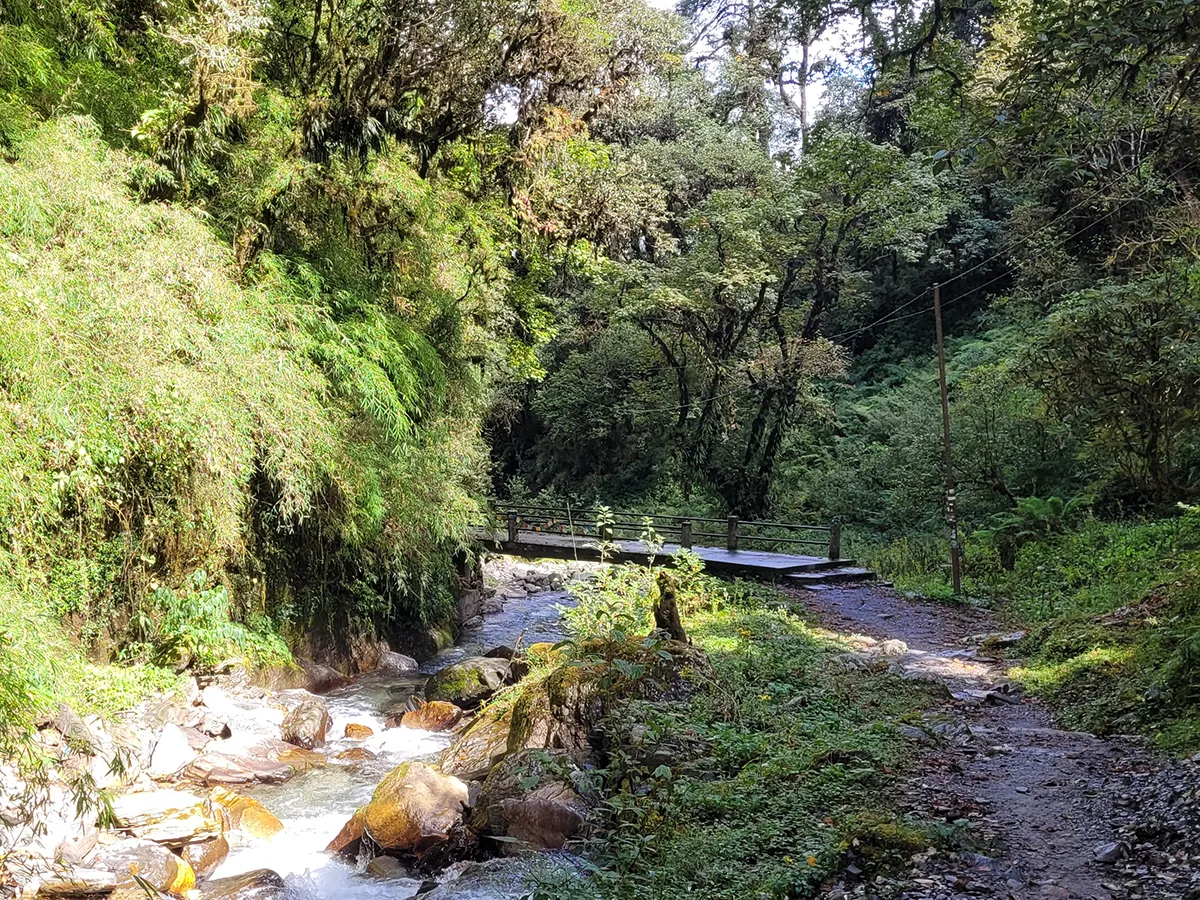
The fourth day of the Poon Hill Trek will start off from the village of Ulleri, which is at 2,070 meters. It is also famous for its stone-paved paths. The trek from Ulleri will be uphill but much smoother compared to the previous day. We will then pass through lush forests filled with tall trees and blooming rhododendrons.
After a few hours of walking, we will reach a small village that stands at an altitude of 2,250 meters, Banthanti, where we will be having our lunch and resting for some time, socializing with other trekkers, making the Poon Hill Trek much more fun. The trail proceeds through forests in a series of ups and downs.
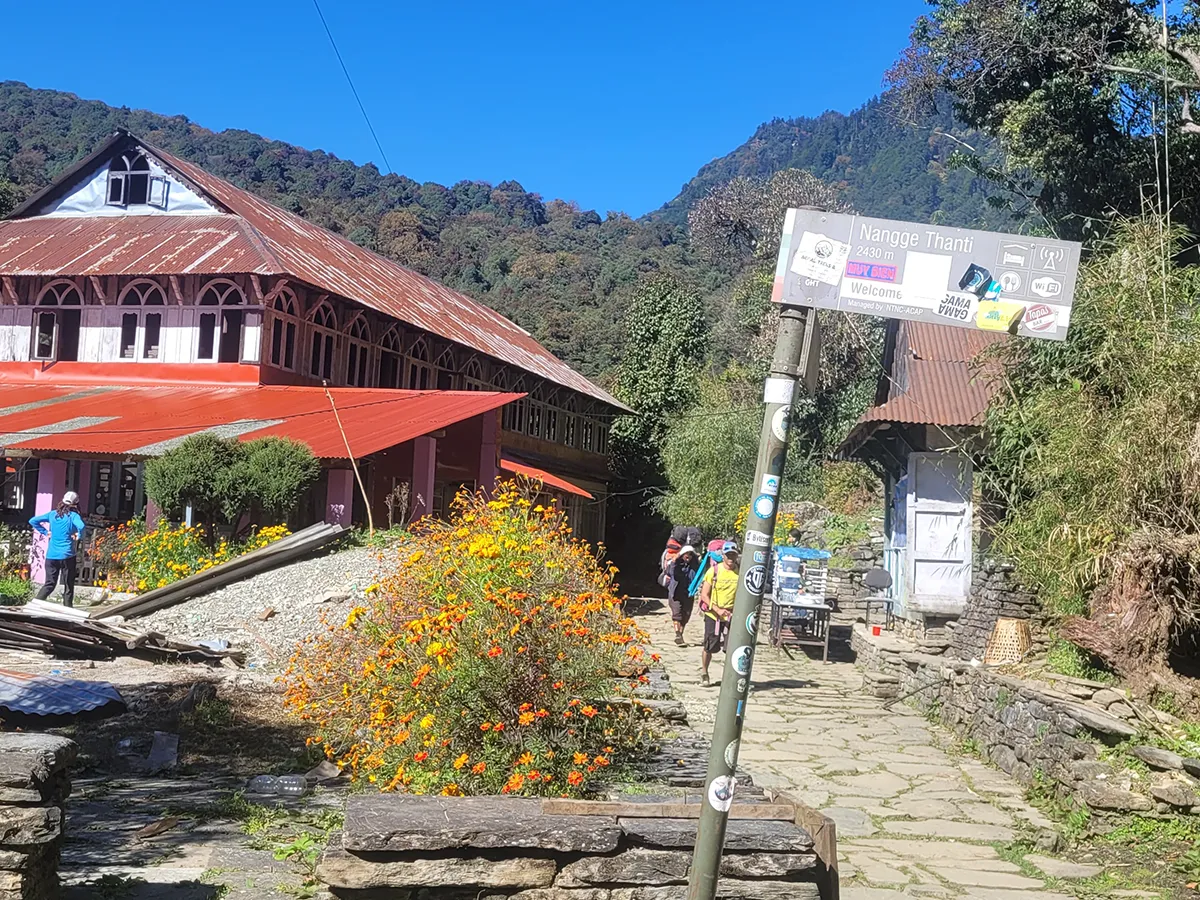
We will reach 2,468 meters at Nangethanti, where we can take our rest for some time and then continue. From there, we ascend towards Ghorepani, enjoying views of the Annapurna and Dhaulagiri ranges from time to time. After several hours, we reach Ghorepani at 2,850 meters, a scenic village where we rest for the night.
The fifth day of the Poon Hill Trek starts with an early rise and ascent to the viewpoint to watch the beautiful sunrise at Poon Hill. Slowly, the sun’s rays start filling in at the mountain peaks of Annapurna and Dhaulagiri, keep getting brighter until they get magical, and will leave us looking up in amazement.
This part of the trek is going to be the best because it comprises those sights that may never leave our minds.
Catching the view of sunrise, we will trek back downhill for breakfast at Ghorepani. Then, after getting refreshed, we will continue our trek down towards Tadapani. On the way from Ghorepani to Tadapani, the trail will be exciting, with small waterfalls, different bird species and bloomed orange orchards lining our way.
We will be able to taste fresh oranges from the local orchards on the trail, adding a special flavor to our Poon Hill Trek experience. In 7 hours of walking, including sunrise and lunch breaks we reach Tadapani and overnight at a cozy tea house.
On the sixth day of our Poon Hill Trek, we will start our descent through beautiful rhododendron forests from Tadapani via downhill trekking. The snow-capped Annapurna Range will be just in front of us in the gleaming morning sun. This part of the trek will be exceptionally serene because of the tranquil atmosphere in the forest.
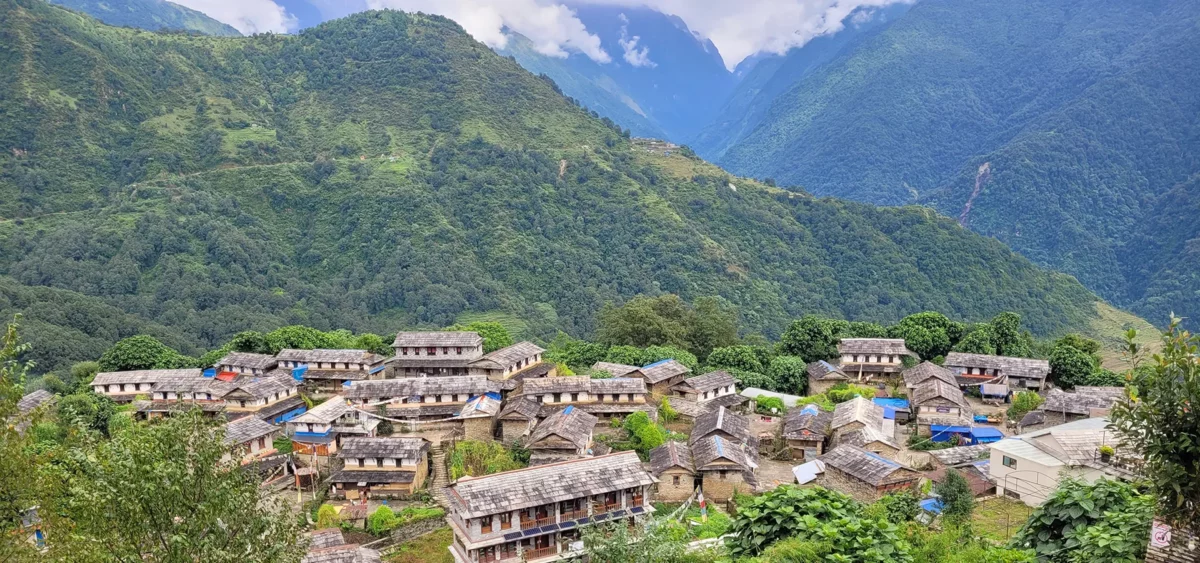
We will continue further on our journey to Ghandruk, which is the biggest hill village of Poon Hill Trek. On the way down, we pass through the picture Gurung villages laced with mist and the beauty of nature. The distance of 8.6 km will take approximately 4 hours.
Approaching Ghandruk at 2,012 meters, the village shows its traditional Gurung culture. Nature’s splendor mixed with richness in culture will create a unique experience in this trek from Tadapani via Ghandruk. Overnight stays will be provided in Ghandruk amidst the hospitality of the locals.
Starting from Ghandruk on the seventh day of our Poon Hill Trek, we will make a final trek to Syauli Bazar by passing through some beautiful rice fields and a few small villages. The peaceful surroundings will give us a perfect farewell from the trek.
Later, about two hours hence, we reach Syauli Bazaar, where finally our trek is going to be ended.
We have to catch a drive back from Syauli Bazaar to Pokhara and drive through the beautiful view of hills and valleys. This drive passes through beautiful landscape and provides one last look at the wild beauty that has defined the Poon Hill Trek.
Upon arrival at Pokhara, we could take a rest day or explore this beautiful city of lakes. Starting from the prime attraction, Phewa Lake, you can take a fresh boat ride, shop for souvenirs, and enjoy the abundant cafes and restaurants, which will make the end of the Poon Hill Trek very memorable.
On the eighth day of our Poon Hill Trek, we bid good bye to the Annapurna region and start driving back towards Kathmandu. The 6-hour drive will follow a scenic road, the Trishuli River flowing beside it, and the undulating landscapes of hills and rivers. This drive is going to be a nice and scenic one.
For those who prefer a quicker option, there is an extra-cost flight from Pokhara to Kathmandu that costs $120. The flight is half an hour and offers great views of mountains and valleys from above, so the extra pay is worth it for a quicker, scenic return.
After arriving in Kathmandu, the day is yours to relax—whether by recharging at a spa or sauna or browsing the lively markets and narrow streets for last-minute mementos. In the evening, we’ll come together one final time for a farewell dinner, marking the end of our unforgettable Poon Hill Trek adventure.
It is the nineth day of the Poon Hill Trek, and finally, we come to the end of our journey here in Nepal. In the morning, our staff will help you with due preparations at your hotel, checking out and then transfer you to the airport for an international departure smoothly.
You can also start anew on a different trek or journey to see more of Nepal’s wonders if one wants to stay in Nepal for a longer period. Starting with additional treks into the Himalayas to cultural city tours, the options for adventure are almost endless.
Whatever the case may be, whether you are going back home or continuing further, we make sure that the last day in Nepal is comfortable and memorable. We would love to see you again for any future adventures.
If our standard itinerary doesn't fully meet your needs, we are happy to tailor it to your specific preferences and requirements.
A private trip offers complete flexibility, personalized itineraries, and tailored experiences. You enjoy privacy, exclusive attention from guides, and the freedom to travel at your own pace, making the journey more intimate and customized to your preferences.
Joining a group tour offers cost savings, added safety, and the chance to meet new people. It provides expert guidance, organized logistics, and a more enriching experience through shared insights and camaraderie.
The Poon Hill Trek can be done the whole year, but each of the seasons can be viewed differently.
Spring, which falls in the months of March, April, and May, is one of the best times when the sky is clear, rhododendron forests are blooming, and temperatures are pleasant.The vibrancy of colors and the clarity of the mountain views make this period a favorite time for trekkers.
The vibrant colors and stunningly clear mountain views make this a favorite season for trekkers. Another great time for the Poon Hill Trek is in the autumn, from September to November, when the weather is steady, the air feels fresh, and the Annapurna range offers breathtaking views.
Winter starting from December to February brings cold weather; the temperature gets notably colder at higher altitudes, with occasional snowfall. Though the trail remains quiet and peaceful, the trekkers need to be prepared for chilled weather. The views of the mountains with snowy caps are spectacular.
Monsoon falls between June and August. This month is very adverse, as it contains heavy rain, slippery trails, and leeches. On the other side, the landscape is green and lush, which offers a very tranquil trek due to fewer tourists. Proper rain gear is important for comfort while trekking during this period.
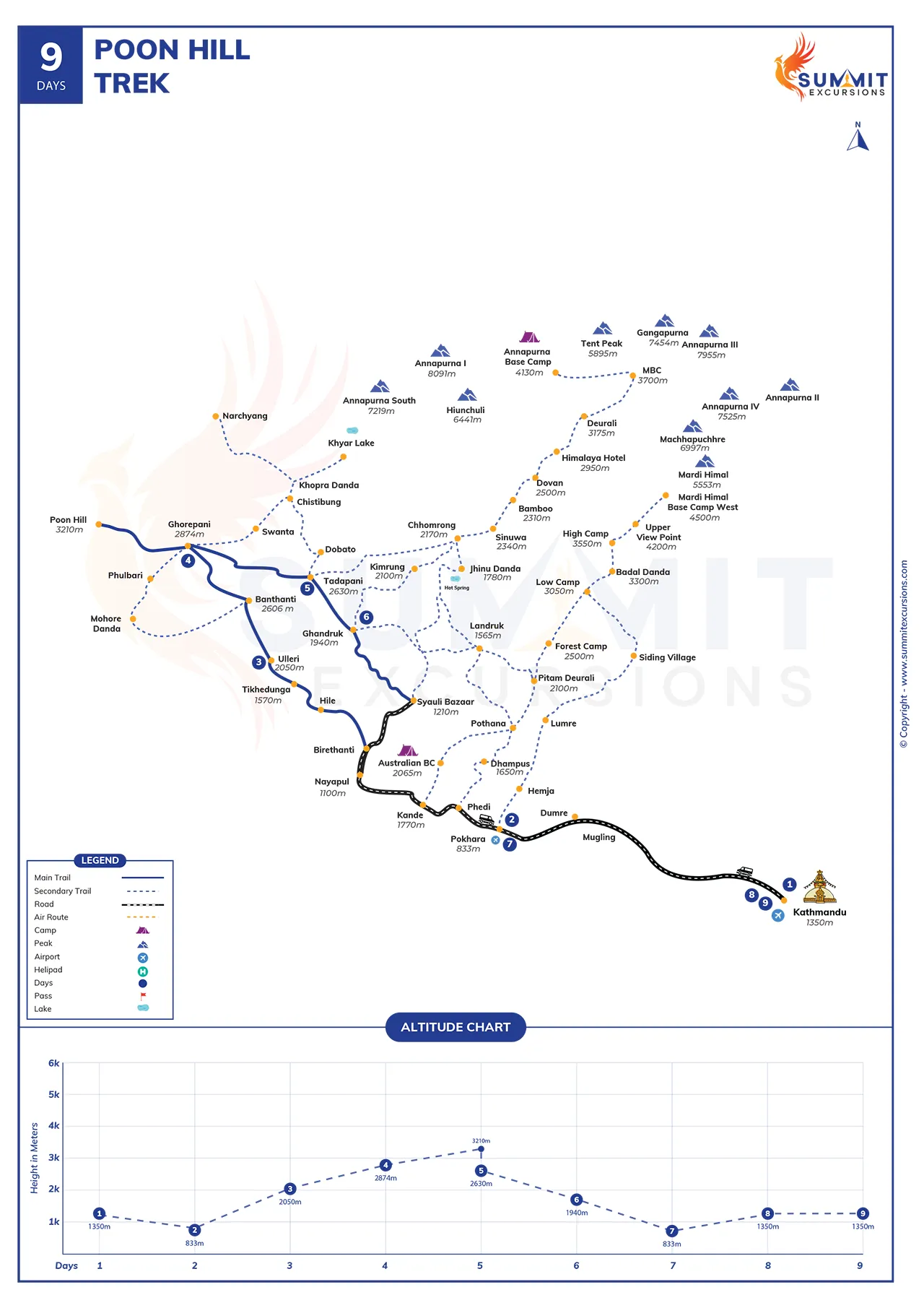
The Poon Hill Trek starts from Pokhara at 833 meters and gradually goes up to its highest point of 3,210 meters at Poon Hill view point. The trek starts with a drive from Pokhara where you will begin your trek from Ulleri, which is 2,050 meters above sea level. The uphill in this strenuous part of the trek consists of 3,500 stone steps.
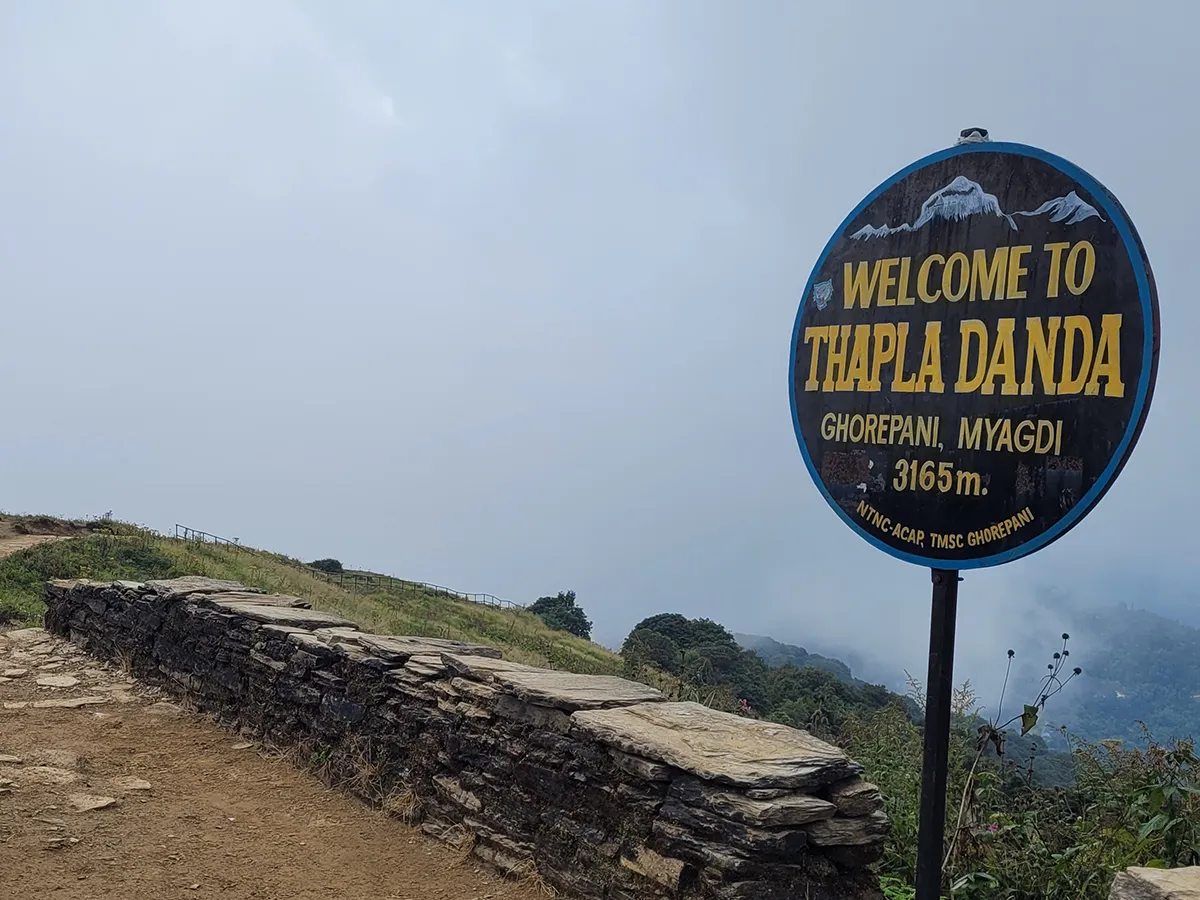
The Poon Hill Trek then goes to Ghorepani at an altitude of 2,850 meters above sea level, passing through the rhododendron forests and charming villages. The next day, you make it up to the viewpoint at Poon Hill, 3,210 meters above sea level, for breathtaking views of the ranges of Annapurna and Dhaulagiri.
The trekking starts downwards from Poon Hill via Tadapani at 2,630 meters above sea level and Ghandruk at 2,012 meters above sea level.
The total distance covered during the Poon Hill Trek is about 40–45 kilometers, which is a rewarding journey for nature lovers.
Poon Hill Trek is a moderate trek suitable for both beginners and experienced trekkers. Although daily walking hours range from 5 to 7 hours, steep uphill climbs are included in the trek, including the 3,500 stone steps leading to Ulleri.
The challenging parts of the trek are mitigated by enough rest stops and scenic breaks, making most fitness levels able to complete the overall trek.
Normally, altitude sickness is not a big problem on the Poon Hill Trek because the highest altitude reached is 3,210 meters. However, some trekkers may experience light symptoms such as headaches or shortness of breath, especially when ascending quickly. It is of great importance to acclimatize yourself properly by pacing and hydrating.
This gradual rise in the Poon Hill Trek gives your body enough time to get acclimatized with the elevation, hence decreasing risks from serious altitude sickness. However, trekkers should not be overconfident and should avoid overexertion.
If properly prepared for it, including taking regular breaks and plenty of hydration, you can take up the Poon Hill Trek very safely without any significant altitude-related problems and find it very rewarding, moving through varied landscapes and mountain views.
The Poon Hill Trek has various hours of walks, where generally the longest walking day falls on Day 5 trekking from Ghorepani to Tadapani, which includes an early morning rise to the top of Poon Hill and generally takes about 7 hours.
Generally, the shortest day of trekking would be Day 7 from Ghandruk to Syauli Bazaar, which has about 2 hours of trekking before driving back to Pokhara.
During the Poon Hill trek, you should be able to walk on average of 5 to 6 hours per day, depending on the landscapes and breaks taken. The trek entails steep uphill climbs, gradual descents and well-marked trails.
Accommodation on the Poon Hill trek ranges from stylish modern hotels to traditional Nepal-style lodges.
In Kathmandu and Pokhara, 2 nights of accommodation in twin-sharing comfortable three-star hotels are provided. The hotels come with all modern facilities, including hot showers, Wi-Fi and breakfast.
The accommodations during the Poon Hill trekking days provide a touch of home-stay style in traditional Nepali lodging. Most of the accommodations are made available in twin-sharing, with clean, western-style toilet and bathroom facilities.
Most of these lodges in remote areas are quite clean, upholding a high level of hospitality along the Poon Hill Trek. Trekkers normally stay in simple yet cozy rooms; dine in communal dining where you get to socialize with your fellow trekkers.
These places combine comfort with an authentic Nepali lifestyle, making memories that will last throughout the whole length of your trek.
During the Poon Hill Trek, you will have a menu that covers your energy needs.
For accommodations in Kathmandu and Pokhara, bed-and-breakfast is provided. You will be provided a farewell dinner in Kathmandu. However, lunch and dinner while staying in these Kathmandu and Pokhara cities are not included in the package so that you can take some time to explore the local cuisine of Nepal.
During trekking days, you’ll have three meals included on the package: breakfast, lunch, and dinner. Chana aalu, toast with jam, coffee, and tea are the ordinary breakfasts, while lunches and dinners include typical Nepalese dishes, or you can choose between thukpa, momos, pasta, etc.
The extra meal, bakery products, and soft drinks are all extra during the Poon Hill Trek. In the same way, you need to pay extra for alcoholic and other beverages. The basic meals are included in the package, but the dining is flexible, and there’s always a place for treats at extra cost.
The Annapurna Base Camp trek is a great extension from the trek to Poon Hill. Being higher in elevation above sea level and with dramatic expansive mountain vistas, the trek to Annapurna Base Camp will be an interesting addition for those who want to do the more classic Poon Hill trek.
This adds up, in fact, to an additional 4 or 5 days to your schedule, making it about a total of 10 to 12 days. The combination of the Poon Hill Trek with the Annapurna Base Camp Trek gives a chance for beholding a much greater diversity of the land structure, from bright red rhododendron forests, stepped farmlands, and rice fields to the mind-blowing mountain scenery at high altitude.
The alternative way provides views of the natural environment and rich cultural heritage of the surrounding area. The Poon Hill Trek is moderately challenging, whereas this added part of Annapurna Base Camp makes the trek a bit more difficult to walk.
Good fitness, stamina, and proper acclimatization to altitude are needed. Daily walking routines range from 4-5 hours up to 8-9 hours, with the highest altitude achieved during this trek reaching 4,131 meters (13,553 feet).
Yes, it is possible for the beginners to take part in this Poon Hill Trek. Actually, this is a moderate-grade trek that is even feasible for the beginners of this type of adventure. The route follows a series of easy ascents and descents along well-marked trails with enough stops for rest.
Generally, Poon Hill Trekking includes 5 to 7 hours of walking every day. Of course, there are some strenuous parts in the trek, such as the steep, stone-stepped climb to Ulleri, but other than that, it is pretty doable for any beginner who is basically fit. Because of the well-structured itinerary, ample time is provided for acclimatization and adjusting to the trekking pace.
Accommodation on Poon Hill Trek offers comfortable lodges and hotels where one may seek warmth after every day’s hike. Most of the lodges are facilitated with basic amenities, which make the trek comfortable for beginners.
The beginners will definitely enjoy all the various landscapes and cultural experiences that make up this trek, and their trekking skills will surely build up with good preparation and an optimistic attitude.
The Poon Hill Trek requires a fair amount of preparation and fitness if the beauty is to be fully enjoyed. It is a moderate trek, but good preparation will make it even more rewarding and safe.
Regular cardiovascular exercises should be started—like brisk walking, jogging or cycling—to develop endurance. Strength training, especially targeting the legs and core, will help with ups and downs during the Poon Hill Trek.
It is also necessary that you train by climbing hills or stairs to help you simulate uphill sections of the trek. By doing this, you will be familiarized with the challenges of the trek—among the steep stone steps that you’ll encounter along the route.
Also, apart from that, do the backpack loading and practice carrying it to get used to trekking with gear on.
Pre-trek acclimatization plays a very vital role in preparation for the Poon Hill Trek. Even though the maximum altitude is 3,210 meters, it’s advisable to spend more time at higher altitudes before the actual trekking so that your body may get enough acclimatization.
Similarly, good hydration and a proper diet also play important roles in physical preparation. In this way, proper preparation will provide opportunities to enjoy and handle the Poon Hill Trek with complete views and cultural experiences.
During the Poon Hill Trek, you can have access to the charging facilities at most of the teahouses and lodges. Most of them have electric outlets in your room where you can charge phones, cameras, and whatever other devices you bring. If there is not one in your room, you are generally able to charge at a common area for a small fee, usually around NPR 100-200 per hour.
Internet access is spotty on the Poon Hill Trek. Wi-Fi may be available in some teahouses, although it can be slow and unreliable, especially in the villages that are deeper in the mountains. It is a great opportunity to unplug and simply let amazing nature around you take your attention for your digital detox.
For those who need to be connected constantly, they can buy a local SIM card here in Kathmandu or Pokhara. Priced at about NRS 110, or 0.9 USD dollars, most new SIM cards contain 1 GB of free data for the first three days. Extra data packs can be added according to requirement, though network performance may vary depending upon the location along the trek.
In addition, data pack recharge cards are also available both in Pokhara and along the trek, besides being in any range starting from Rs. 50-100 and offering flexibility about keeping in touch on a journey.
The Poon Hill trek requires two important permits: the Annapurna Conservation Area Permit and the Trekkers’ Information Management System card. Both of them help to conserve the natural beauty of the site and maintain the infrastructure of the area, along with the assurance of safety among trekkers and locals.
The TIMS card is compulsory for all trekkers in Nepal. It monitors the safety and security of trekkers in the region by making them traceable. It costs NPR 2,000 (approximately $18 USD) for foreign nationals and NPR 1,000 (approximately $9 USD) for foreigners who go on a trek with a guide. You can obtain the TIMS card from the Nepal Tourism Board Office in Pokhara or Kathmandu.
To enter or pass through the Annapurna Conservation Area, an ACAP is required. This permit contributes to the conservation of the natural and cultural heritage of the area. The ACAP charges for foreign trekkers are NPR 3,000 (approximately USD 25), while for SAARC nationals, the charge is NPR 200 (approximately USD 2). The ACAP can also be obtained from the Nepal Tourism Board Office in Pokhara or Kathmandu.
The permits are included in our package and our staff from the company will obtain all the required permits for you, ensuring you a hassle-free trek.
Airport transfers to the hotels for the Poon Hill Trek are conveniently handled with a private vehicle. This provides comfort in pickup and drop-off service at the airport to and from your hotel.
The transportation from Kathmandu to Pokhara and vice versa is arranged by a shared luxury tourist bus, which allows comfort with scenes of the Nepalese countryside, making the travel very pleasant between these two major cities during the Poon Hill Trek.
After your arrival in Pokhara, you will be taken by a private tourist jeep from Pokhara to Birethaiti and from Syauli Bazaar back to Pokhara.
This could be arranged in case of an emergency, that is, a helicopter evacuation. It is, however, extra and not part of the package. This is an option for safety during the Poon Hill Trek in case any unforeseen circumstances occur.
The Kathmandu-Pokhara-Kathmandu domestic flights are not included within the package price but will be arranged at an extra cost of US$ 120. This saves you a great deal of time and provides views of the Poon Hill Trek area as seen from above.
Though safe and accessible, the Poon Hill Trek requires you to have trekking insurance, which would cover any probable sickness or accidents that might occur so that you could be assured of protection during it.
The highest altitude reached on the Poon Hill Trek is 3,500 meters, and high altitudes involve certain risks for travelers who have not previously experienced them. Your insurance policy should cover medical expenses, emergency evacuation, and cancellations of the trip.
Comprehensive travel insurance will give you peace of mind for the wonderful landscape and experience of trekking. Make sure your policy actually covers conditions relevant for the Poon Hill Trek so that you can best ensure security.
The Poon Hill Trek definitely takes your breath away on an adventure through the beautiful Annapurna region. Indeed, it is one of those treks offering spectacular views of the snow-capped peaks of Annapurna, Dhaulagiri, and Machhapuchhre, which makes every day a treat to watch.
The Poon Hill Trek is far more exciting because it takes you through the cultural aspects of the places, as it passes by the traditional Gurung and Magar villages. You will just be among these friendly local communities, which are pretty much interactive with rich cultural added into your journey.
Poon Hill Trek takes one through a variety of landscapes, right from the rhododendron forests up to the terracing fields to the highland topography. Besides, the trek has been graded as fairly easy because the roads are well-maintained and the route follows a path that is scenic and easily presents the natural beauty of the region.
Finally, take a nice morning view of the sunrise from Poon Hill. This viewpoint is very famous and offers a stunning panoramic view of the Himalayas, which is worth getting up early in the morning for.
Spring, from March to May, and autumn, from September to November, are considered the best times.
It’s a moderately graded form of trekking, ideal for beginners who can retain their average fitness level.
The highest altitude is 3,210 meters at Poon Hill.
You require an Annapurna Conservation Area Permit (ACAP) and a TIMS card.
Pack in layers of clothes according to the seasons, hiking boots, waterproof jackets, and trekking poles.
Yes, it is recommended in case of medical expenses or emergencies.
Likewise, most of the lodges offer charging facilities; although extra, it would be wise to carry extra batteries.
It is available but very slow; it’s best to purchase a local SIM card in Pokhara for communication purposes.
Transportation will be arranged in private vehicles, shared buses, and private jeeps.