


12 Days

Easy

5,320m

Nepal

2-16

3 star hotel, Lodge


B, L, D
Explore more facts about the trip
US$ 1499
Dozens of trekking routes of varying complexity and length have been laid across high-mountainous Nepal but nothing like the Nar Phu Valley trek. These high mountain valleys are an unusual non-tourist hike in a closed mountain area, where there are few people and stunning views and places.
Many travelers heading to Annapurna are often unaware of this high-altitude valley, previously considered the hidden land. And, this is probably the specialty of the Nar Phu Valley trek that is lost in time completely untouched by mass tourism.
Opened only in 2003 to organized trekking groups, the Nar Phu Valley lies gracefully at the offshoot of the Annapurna circuit trail leading adventurous hikers to Manang.
Encircled by the astounding frozen peaks of Kanguru in the east, Pisang in the south, Damodar in the north, and Kang La Pass in the west, both valleys boast bizarre rocks, ancient forests, and the fascinating culture of the Himalayas.
On the other hand, this very special Nar Phu Valley trek also offers an extraordinary opportunity to experience the Tibetan Buddhist culture of the Khampas, the ancient Tibetan refugees who sought refuge in this area.
They live from herding, from poor agriculture (barley, millet, potatoes), and, above all, from the collection of Yarsa Gumba, a miraculous mushroom that grows up to 5000 meters.
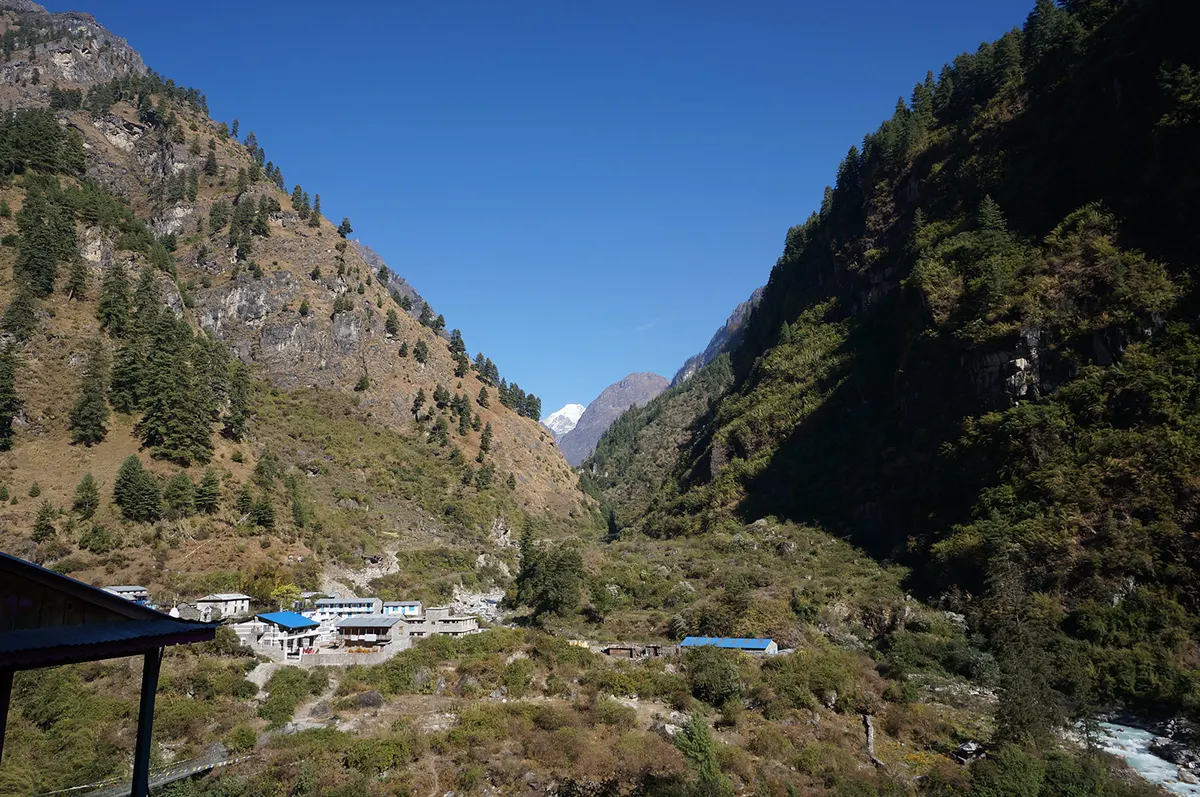
In terms of our Nar Phu Valley trek itinerary, our walking route will take you away from the common tourist trail through the narrow gorges, medieval villages, past impressive Tibetan stupas, and herds of blue sheep.
Here you will be left alone with the dozens of great mountains unknown to most – the formidable Himlung 7126 meters, the pyramidal Pokharkhang 6372 meters and the Kanguru a few meters below 7000.
Our astonishing 12 days Nar Phu Valley trekking journey starts from Koto, a sweet Nepalese village in the middle valley of the Marshyangdi river, to extend towards Tibet with two distinct branches.
You will walk in the remote tracks through Meta to Phu Gaon, Nar Phedi, to Nar Gaon, and cross 5320 m Kang La Pass that blesses the extraordinary gigantic views of Annapurna Massifs. This pass connects Nar with the villages of Manang and Bhotia in the Nyeshyang Valley.
You will then continue on the Annapurna route, which is the great and famous trekking destination in Nepal, with the fantastic towns of Ngawal and Chame in the Tibetan highlands to Kathmandu.
Overall, the transitioning journey of the Nar Phu Valley trek is technically unproblematic, and the altitude usually does not cause any problems thanks to experience and slow, steady altitude acclimatization. Thus any traveler exploring this part of the world will treasure the natural, cultural, and historical heritage.
Welcome to our 12 days Nar Phu Valley trekking trip, a very special Himalayan trek that we can warmly recommend.
It is our utmost pleasure to welcome you on your first day in Nepal. Our appointed delegate with driver and car will be at TIA Gate to cordially receive you and to escort you to your hotel.
Already in a short drive through the city network, you will see the classic mystique and a wonderful whirlwind of classic Nepal. After all our participants arrive, our guide will host a short meeting to explain about our Nar Phu Valley trek.
He will also review your gear, and help you rent one if needed. In the evening, you can take advantage of the delightful nightlife of Kathmandu.


Get ready for a long but nice drive out of Kathmandu Valley to Dharapani. Our private tourist vehicle will drive you over Thankot to Trishuli River. After about 5 to 7 hours, the very elongated village of Besisahar (760 m) hinting we are now at Marshyangdi valley.
Now, we will drive along Jagat from where the road is now steeper leading us to Chamje accompanied by the impressive Marshyangdi River. Next, the long street of Tal (Lake) Village hails us which is primarily known for its gigantic waterfall.
As we come out of Tal, we pass our first Mani Walls. The road becomes more steeper, rugged, and impressive till we reach Karte from where Dharapani is a very short dive.


Our road to adventure begins! We will now go west through the shady rhododendron, fir and pine forests to Bagarchhap (2160 m) where the wonderful spectacle of Annapurna II and Lamjung Himal awaits us. Shortly, we will come to 2300 m Danakyu and Timang where the old path between the lowlands and Manang descends.
We will now pass through 2400 m Latamarang before reaching the small settlement of Koto, located at the outlet of Phu Khola.
We will leave Annapurna at Koto and continue due north into the valley leading to Nar and Phu. Before we leave Koto, we will register with the special permit for Nar and Phu.
After this, we will go down and cross the bridge, from where it starts flat and easy. We now move into the impressive gorge and pass a small hot spring and a number of small obstacles by the river.
In Soti Khola, we may have our powering Dal Vat, then continue on towards 3220 m Dharmashala. The path will persistently rise steeply yet the beautiful Pisang, Annapurna II, and Lamjung Himal will make our tiring feat an easy journey. Next, the sharply increasing path takes us to Meta for our evening.
Walking for about 4 hours through the few scattered jungles of rhododendrons and birch, and desolate highlands, we will arrive at Kyang.
We are now about to enter the gorgeous Phu Valley. But before that, we will have to walk upward sharply for about 10 to 15 minutes beside the Phu Khola to Phu entrance gate.
The enchanting sights of Kangaru, Amotsang, and Pokharkhang will be welcoming in the village.
Today, we have an incredible chance to discover the Tashi Lhakhang monastery of the Phu Village. After the monastery, we can go to the Phu Pass rising to 5050 m to acclimatize. The astounding upward climbing will make us gain more than 1000 m but the fruitful reward is high with Kangaru, Bhrikuti, and Himlung in front.
On the other hand, you can also make it to the slightly lower base camp of Himlung at 4900 m. we need to return to our shelter early to gear up for our onward journey.
After Phu, our road continues south towards Jhunamghot. We will now walk down steeply towards the Mahendra Bridge which we will cross. Now the track is petty simple that will shortly take us to Nar Phedi.
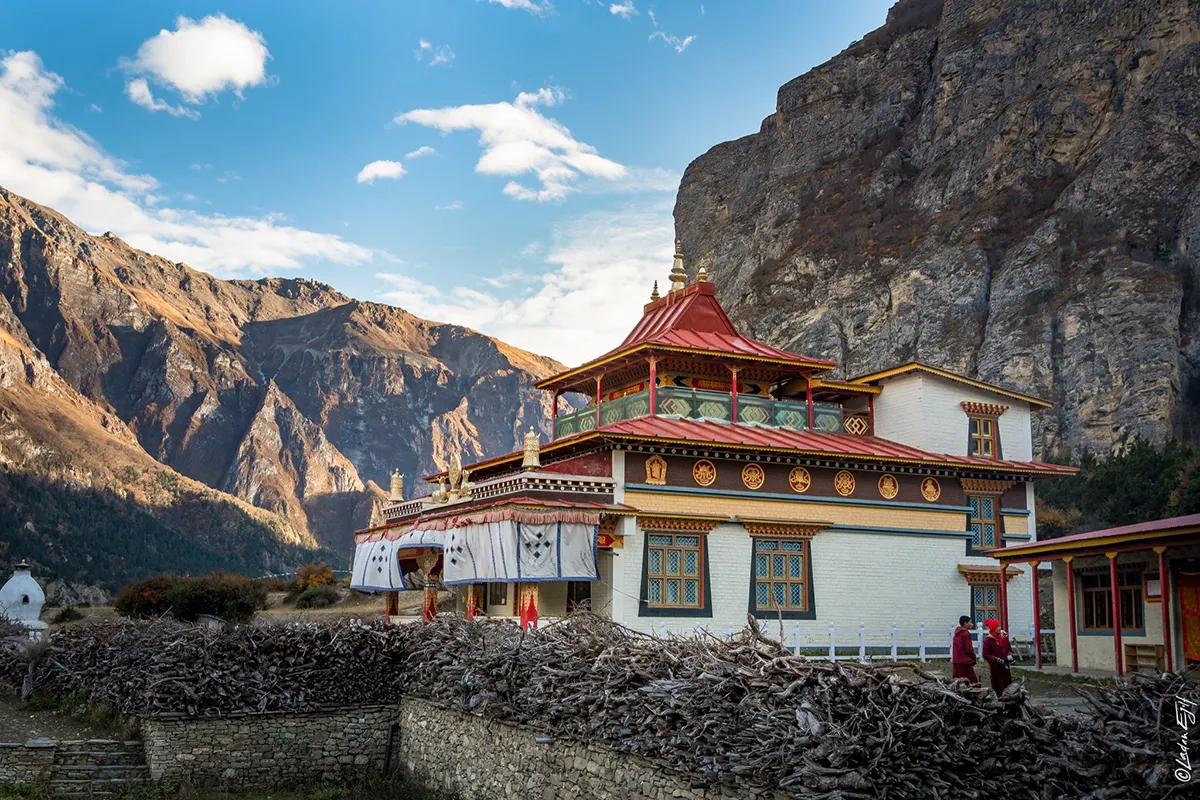
In the native dialect, the village is referred to as Yungar known for the attractively seated Nasadak Changu Tashi Choling monastery with its comfortable lodge.
We will climb up vertically from the monastery to Nar Gaon. There are large Mani Walls, an expansive landscape, and some sharp segments to cross. But the 6367 m high Kanguru Himal with its massive face will always be with us.
The blue sheep will also be our occasional visitors along the track while from the village, the prominent 5320 m Kang La Pass will also come into view- our dreaded pass to cross tomorrow.
After taking some time to rest at the lodge, we will set out to discover the tiny hamlet, its streets, and Gompas. However, we will rest as much as possible, as we will be facing a long and challenging day ahead of us tomorrow.
Today, we have to get over the gigantic Kang La Pass which is not really difficult except for its height. The track till Kang La Phedi is smooth though long.
Watching the Kanguru, and Ganesh, we will walk through the mound of Temdenzon Khola. There are numerous yak pastures here with shining Pisang Himal at the distance.
Eventually, the foot of the Pass Kang La Phedi or Jhumbu Kharka will be reached. Now, the main challenge commences as we climb over the ridges and traverse a small alpine stream.
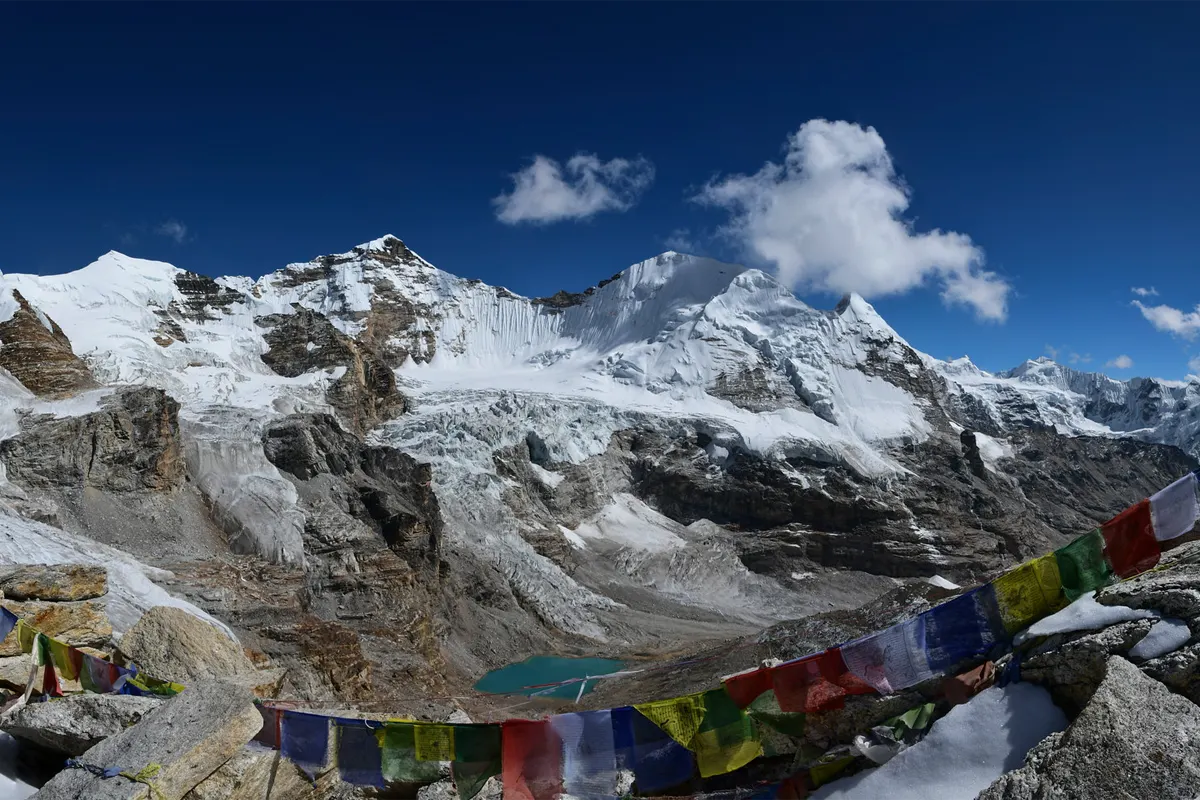
The Pass summit is very narrow however the unique top-class views here are nowhere comparable. The Kanguru, Himlung, Annapurna II, III, IV, Gangapurna, and Tilicho shine brightly like we can just reach and touch them.
Now, the strenuous downhill trek is ahead of us which for the first few hundred meters will be very steep. Then the terrain slightly starts to flatten out till we arrive at Ngawal.
Viewing Annapurna, we will move down through the vast and dry Tibetan topography towards the Upper Marshyangdi valley. Then, we will move to Pisang and reach Chame which is the major and the fine town of this Valley.
Our appointed private four-wheel will pick us up from Chame and drive us back to Kathmandu. The journey will be lengthy, but we will make regular stops along the way.
Driving through the well-known Koto, Dharapani, Tal, Jagat, and Besisahar we will reach Kathmandu probably late in the evening. Then gathering with the team, a refreshing and tasty farewell dinner will be enjoyed in one of the finest restaurants of the city.
You will say goodbye to Nepal today and accompanied by our staff, you will drive to TIA in our vehicle and land in your home country after a great adventure of 12 days Nar Phu Valley Trek.
If our standard itinerary doesn't fully meet your needs, we are happy to tailor it to your specific preferences and requirements.
A private trip offers complete flexibility, personalized itineraries, and tailored experiences. You enjoy privacy, exclusive attention from guides, and the freedom to travel at your own pace, making the journey more intimate and customized to your preferences.
Joining a group tour offers cost savings, added safety, and the chance to meet new people. It provides expert guidance, organized logistics, and a more enriching experience through shared insights and camaraderie.
If you wish to fully glorify in the exquisite charm of Nar and Phu, then spring (March through May) will be a brilliant time. Temperate weather, minimum rain, and brilliant blue skies make this season the best to completely be in the solitude of the magical Himalayas.
This season brings in the 8 degrees Celsius during the day suitable for the brisk walks in between the giant rhododendron trees.
The autumn period (September through early December) is another splendid time for the 12 days Nar Phu Valley trekking adventure accompanied by a delightful heat of 20°C and the nighttime coolness of 5°C.
The contrasting foliage in the forests with a dry atmosphere often creates a beautiful opportunity for meeting with the blue sheep.
Since, the region is blocked by the Himalayan barrier, the monsoon (June through August) is not at home in Nar and Phu. However, considering the journey starting from Kathmandu, we must be mindful of the high rainfall effects of landslides.
On the other hand, during the winter season (late December to February), the area will be enveloped in thick and dense snow making the high Kang La Pass almost impassable.
The highlanders often dwell in lower regions and the basic setting may not give you the needed warmth and comfort. However, the white landscape of the region will be particularly extraordinary.
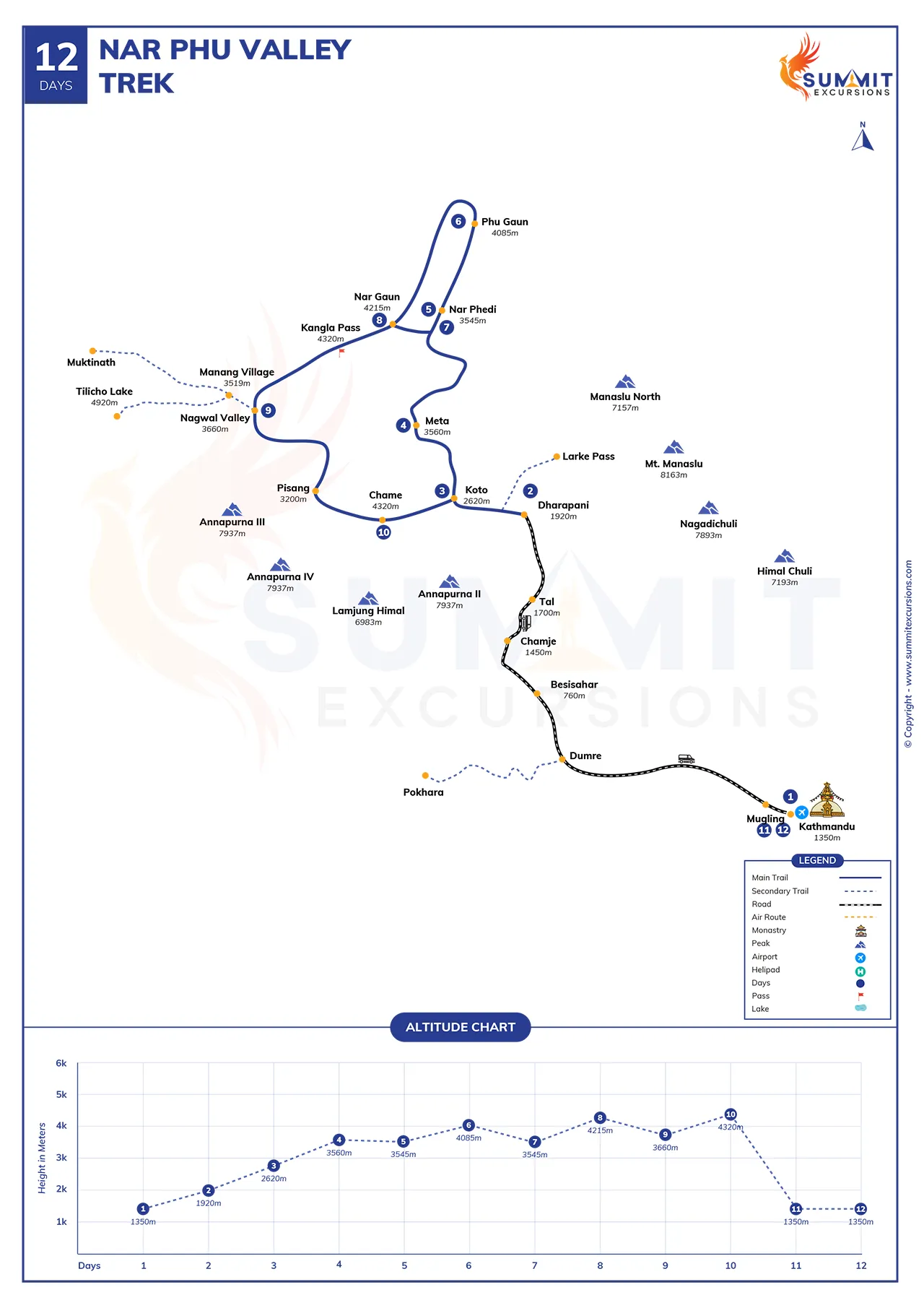
Stretching approximately 75 to 80 km, our 12 days Nar Phu Valley trekking takes you through the rich landscapes including cool alpine forests, cultivated fields, and rugged cliffs.
Here the Annapurna group parade their immensity to the south while to the north there are a succession of high cliffs that end over 7000 meters on the border with Tibet.
Koto will be the small gorgeous village marking the beginning of our trek sitting 230 km from Kathmandu. From Koto, we will travel precisely 20 kilometers to reach Nar Gaon.
When journeying through this unique landscape, we will live for a night in Nar Gaon which rises to 4100 m making this settlement our highest overnight altitude of the entire Nar Phu Valley trek itinerary. Whereas, the 5320 m high Kang La Pass linking the Nar Gaon to Manang will mark our highest elevations.
For many years, the Nar Phu Valley remained hidden from the eyes of the Nepalese government, thus preserving its status as a Secret Valley. With the arrival of Tibetan refugees and the initiation of the salt trade, it gradually came into the eye of the authorities.
It wasn’t until 2003 that trekking in the area was entirely prohibited. Today, the Nar Phu Valley trek comes under the specially protected zone to manage the flow of foreign tourists.
One of the main reasons for this classification is the primitive nature of the two valleys which transport people back to the Medieval Age largely untouched by modern influences.
Nepal government aims to maintain the two Valleys’ purity, tranquility, and safety, avoiding overcrowding. The government also wants to prevent the trek from becoming another popular route like the Everest Base Camp or Annapurna Base Camp.
Additionally, the nearness to Tibet also requires careful management to avoid any potential issues with neighboring China.
Therefore, a special permit is essential for the Nar Phu Valley trek itinerary for which you must be a part of a group of two or more participants accompanied by a local guide.
The 12 days Nar Phu Valley trekking is regarded as an upper intermediate level trek corresponding to Annapurna Circuit, Manaslu Circuit, and Everest Base Camp treks. The paths are generally very good, but periodically they are quite spectacularly carved into the hillsides.
The trek contains hiking days of 6 to 8 hours duration with the massive Kang La Pass crossing on day 8 that requires almost 8 to 9 hours. This is the longest day when we climb 1200 m and descend almost 1700 m on the same day. But strangely enough, the pass is no harder or longer than either Larkya La, Thorung La, or Cho La – almost shorter.
Another challenge that you will face in the Nar Phu Valley trek is the limited lodging options en route. The towns of Nar and Phu actually correspond in terms of development to the Annapurna and the Marshyangdi Valley’s Manang and Pisang 35-40 years ago.
An additional challenge is presented by the harsh weather conditions, similar to those of Tibet where there is a large difference in temperature. Days can be extremely hot, while nights may become quite cold.
The weather is unpredictable, and strong winds are common. Therefore, a reasonable level of fitness, endurance, and adaptability is essential for this tour.
The Nar Phu Valley trek itinerary is similar to a journey through Tibet. It involves a significant elevation change from flat lowlands at 1350 m to an altitude of 2,600 m within a single day, nearly doubling the altitude gain.
On the second day, trekkers will reach 3,560 m, marking an increase of almost 1,000 m. This pattern of altitude gain continues, culminating at Nar Gaon at 4,100 m and Kang La Pass, at over 5000 m.
Such rapid elevation changes may present challenges for new trekkers who are on their first adventure in Nepal. Additionally, the changeable weather pattern, the large temperature variation in day and night, and the daily walking journey of up to 7 hours do require a certain level of trekking experience.
For those new to hiking in high-altitude environments, these challenges can be a quite hardship. Therefore, we suggest you take some easy acclimatization trips, such as the Langtang trek or Poon Hill trek, before committing to this trek.
Many people think that altitude sickness can only occur at extreme altitudes but this is a dangerous mistake. Altitude sickness occurs at relatively low altitudes as well probably above 2500 m.
According to our Nar Phu Valley trek itinerary, you will transition from 1350 m height to 2600 m in one day when traveling from Kathmandu to Koto.
Then the altitude goes on increasing as the journey progresses further ultimately reaching 4100 m at Na Gaon. And don’t forget, you will also have to cross over the above 5000 m Pass en route. Plus, the air in the Nar and Phu Valleys is drier with less humid.
All these along with your negligence not to follow the significant guidelines of acclimatization often lead to altitude sickness. However, the altitude acclimatization is fantastically good on our version of the Nar Phu Valley trek.
We will take it very quietly on the way up to Phu, take a day off, and walk only two hours to Nar Gaon from Nar Phedi. However, even after following all the necessary acclimatization steps, there may remain a possibility of developing altitude sickness.
By following the tips we have listed below, altitude sickness can be prevented to a large extent:
You will have two nights in the cozy setting of a three-star hotel. Your room will feature twin beds for sharing with a private bathroom, including a hot shower and Wi-Fi.
Accommodation during 12 days Nar Phu Valley trekking will be in lodges usually in a double room where in addition to beds, at best, there will be a small nightstand. In most cases, there will be a blanket, but not always – so a sleeping bag is a must-have.
In Kathmandu, we will serve breakfast only, leaving lunch and dinner up to you. But don’t worry—while trekking, full board meals, including breakfast, lunch, and dinner will be served at the lodges.
Most lodges have a menu that runs several pages, but it basically boils down to a few basic dishes (rice, potatoes, momos, pasta, noodles, curry, eggs), each with optional toppings (vegetables, cheese, eggs, chicken, meat, canned tuna).
If you want to enjoy some bakery items, soda, alcoholic beverages, or other drinks, keep in mind that you will need to cover the costs yourself.
Our Nar Phu Valley trek itinerary cost covers not only accommodation and meals but also all transfers. All the transfers from the beginning to the conclusion of the Nar Phu Valley trek will take place in private vehicles including airport pickups and drop-offs, as well as road transport from Kathmandu to Dharapani and back from Chame to Kathmandu.
Regarding communication, Ncell and Nepal Telecom are the two leading operators in Nepal. In the Nar Phu Valley trek, the latter generally works better.
You can buy a Nepal Telecom card right in Kathmandu and it is better to do it on the very first day of your arrival. To purchase a SIM card, a passport with a valid visa and a photo (as for a visa) are essential.
In addition to the SIM card, you need to top up your account and choose a package. The seller can top up and activate the card, as they say, right there at the shop.
On the trek, Nepal Telecom has 4G coverage. In fact, you can call and send SMS more or less without problems, the Internet is very sporadic, and it works best at night. There is also access to WiFi which sometimes can be complimentary for guests.
Nar Phu Valley has access to electricity through solar panels or local hydroelectric power for charging but for extra money.
If you are thinking of participating in our 12 days Nar Phu Valley trekking, then, obtaining travel insurance should be your top priority. These remote valleys near Tibet present challenging climatic conditions and high altitudes.
These are the settings where there can be possibilities for unexpected events, such as accidents, ankle sprains, injuries, infections, and the risk of severe altitude sickness. While in some extreme situations, emergency rescue by helicopter may be needed.
In addition, being a specially government-protected area, you will need to pay $500 for a special permit which will be granted only after you show your policy document.
Therefore, make sure, your policy addresses trip and flight cancellations, emergency helicopter mountain services, injuries, medical expenses, accidents, and the loss of luggage costs.
The best way to completely unwind in the Nar Phu Valley trek is to go well prepared. On this trip, you will be covering large distances and greater elevations up and down. Therefore, make sure you are fit when you go on this tour which allows you to walk further and therefore have more fun.
Give your body enough opportunity to adapt to the new heights and atmosphere. Start with a few easy warm-up tours (Ghorepani Poon Hill, Tamang Heritage Trek, Langtang Trek, etc) so that you feel what you and your group members can handle.
You can also do a lot of exercises at home to be fit when you go into the high rugged terrain of Nar and Phu. By simply walking a lot, you already lay a good foundation. By climbing stairs a lot, you can train for climbing and descending. Cycling, squats, running, push-ups, and swimming will help you build endurance.
You can enter the Nar Phu Valley only with a special permit (Restricted Area Permit- RAP) valid for seven days. Seven days, if all goes well, are enough to reach Phu, then Nar and the Kang La Pass. The cost of this government permit is about $100 per person for autumn and $75 for winter and spring.
A prolonged stay beyond seven days will cost an additional $10 to $15 per person per day. This permit is submitted by an Agency and issued by Immigration in Kathmandu.
Additionally, the Annapurna Conservation Area Permit (ACAP) is another document necessary for our 12 days Nar Phu Valley trekking trip granted by NTB (Nepal Tourism Board) costing $30 approximately.
No, solo trek is not possible in any trek in Nepal since April 1, 2023. plus, the valleys are the restricted areas where you must travel in a group of at least 2 people.
The Muktinath Jomsom trek can be combined with the Nar Phu Valley trek itinerary, which will require an additional five to six days. From Ngawal, you walk to Manang, Yak Kharka, climb up the 5416 m Thorong-La pass, and then move down to Muktinath and Jomsom.
Yes, you can climb the Himlung Peak at 7126 m from Phu Gaon.
Many of us are familiar with Everest and Annapurna, but the Nar Phu Valley trek offers an opportunity to see the least-known peaks of Nepal such as Pokharkhang, Kanguru, Himlung, Gangapurna, Damodar, and Pisang. This trek is more about the pristine pure nature that will take you back to the medieval era, where people are still honest and simple.


