




12 Days

Easy

5,357m

Nepal

2-16

Hotel, Lodge


B, L, D
Explore more facts about the trip
US$ 1450
The Gokyo Lake Trek is one of the most scenic Himalayan treks you can go for. The Gokyo lakes are considered to be holy and are something that looks very out of this world. The turquoise color of the lakes, reflects the scene of the mountains in the distance, making for a great aesthetic scene. You will visit and stay in the vibrant town of Namche for 2 nights, making the most out of your limited time in the highlands.
One of the best things about this trek is that you not only get to enjoy the amazing natural scenery of the Gokyo lakes and the Khumbu region but also get a glimpse of the daily lives of the remote Himalayan villages of Nepal. The countryside of Nepal offers a unique experience far from the bustling cities, away from your busy lives.
The Gokyo Lake trek is a group trekking experience where you will travel alongside your families and friends with a shared enthusiasm for the remote countryside and trek.
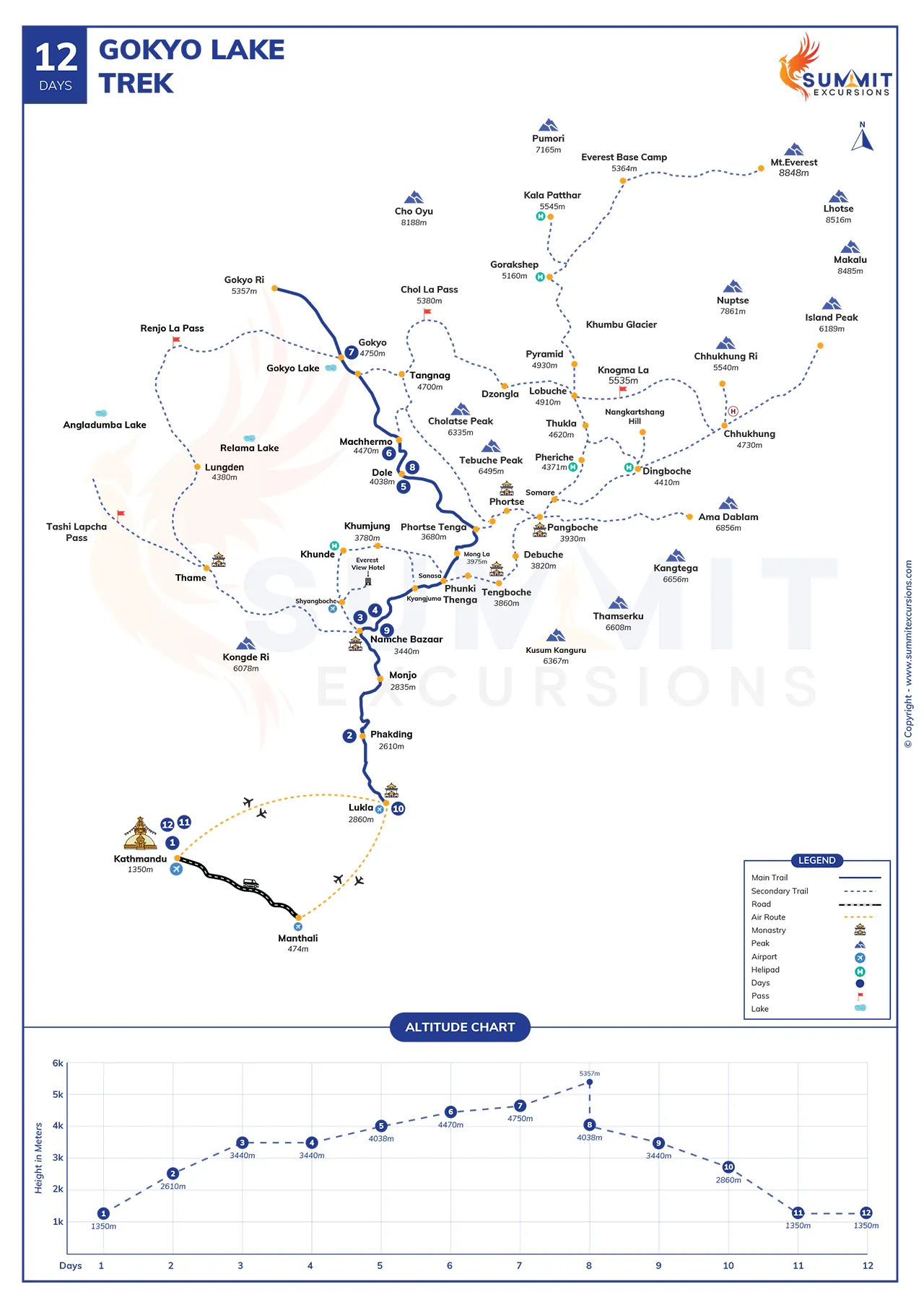
Starting the trek off from Lukla, the gateway to Everest, we will first trek to Phakding, followed by a trek to Namche Bazaar the next day. We will stay at Namche for a day to let our bodies acclimatize to the change in elevation and environment. As we ascend further into the valley, gaining altitude as we go, the air gets thinner and the amount of oxygen in the air decreases.
This decrement of oxygen in the air calls for altitude sickness if we are not careful enough, which is why we will be going slowly and steadily gaining the recommended altitude each day instead of pushing ourselves further. If you are an experienced trekker and would want to complete the trek a couple of days sooner, you can try going further than the standard day-to-day itinerary.
But in doing so, you are risking altitude sickness which can make you quit the trek in an instant. So, it’s always to your advantage to go slow and steady.
When it comes to accommodation, you will be staying in tea houses owned and operated by local families. These remote villages in the Khumbu region are not easily accessible which makes it difficult for them to have a steady income source. Their main source of income is tourism which is why they provide rooms at cheap prices, even cheaper than the ones you will find in cities.
But once you stay in their accommodation, you should have all your meals there. It’s an unspoken rule. The accommodation price is cheap and their only selling point is the food they provide.
Arriving in Kathmandu memorable experience in itself as the overhead scenes from the plane are one to remember and since it’s the start of the trek, you will be excited to get started. It’s always a better thing if you arrive during the daytime as you will have more time to prepare for the trek, gather your equipment, pack your bags, making sure that you have everything you need.
You can also buy trek necessities up in the mountains but it will cost you almost twice the standard rate as the transport charges add up. The Khumbu region villages are not easily accessible.
Once you get off the plane, you will have to visit the immigration booth at the airport to get your visa on arrival. You do not have to do anything for a visa beforehand. You simply have to arrive at the Tribhuvan International Airport in Kathmandu with 2 passport-sized photos, a valid passport (minimum of 6 months), return flight tickets, and proof of accommodation.
On the 2nd day of the Gokyo Lake Trek, we will take a flight to Lukla. This flight is short and scenic, as you near the Lukla airport, you will enjoy the views of the different peaks of northern Nepal. One thing to note; flights to Lukla are frequently canceled due to bad weather, even if the weather seems nice in Kathmandu, storms can be brewing in Lukla.
In such as case, we can arrange a shared helicopter ride to Lukla which will cost you USD 450 per person. Since helicopters are more flexible in terms of landing and more maneuverable, they are safe even during bad weather. This helicopter ride is not a part of the Gokyo Lake Trek package, this is with an alternative additional cost
We will pass the Dudh Koshi, a roaring alpine river, twice today. The name Dudh Koshi translates to “Milk River” which is a fitting name since its water is completely creamy-white. The day’s trip passes through forests of pines and oak in some places and open spaces that show rows of fields with a number of different highland crops.
Along the way, we might come across a handful of yaks, mules, and dzopko (cross-breed between yak and cow) bringing in commodities and trekking equipment. Since Yaks are more suited for the snowy highlands, Dzopkos are the best bet when it comes to traveling to the lowlands to load the goods.
Gradually gaining height, we will pass via a number of little villages before reaching Phakding. Beautiful towering mountains stretch out over us, appearing to float beyond the forest line as they ascend over the dark river gorge.
The Kusum Kangru peak, reaching 6369 meters in height, is visible as we pass the Kusum River. The Kusum Khola River ultimately feeds the Dudh Koshi River down the slope. Beyond the route, Kongde Ri and Nupla soar over the densely wooded slopes to the northwest.
Thamserku stands gloriously at an upward turn as if it were rising out of the riverbed. Today, you will get to see Mani walls for the first time during this Gokyo Lake Trek. These carved stones are made up of a collection of several stone slabs expressing the mantra “Om Mani Padme Hum,” which means “Hail to the jewel in the lotus”. This mantra is honored by both Buddhists and Hindus.
As per Buddhist practices, you are supposed to walk on the left side of these Mani walls. Please be considerate of their religions and try to follow their practices as much as possible. The same thing applies to Chortens (small stupas). You will see Chortens in every village you will pass by.
We will cross the creamy-white waters of the Dudh Koshi and enter the Sagamartha National Park after getting our permits verified by the officials at the checkpoint. The creation of this conversation area represents a major effort to reduce the amount of timber used in the region.
Independent trekking parties are required to cook exclusively using kerosene fuels. Although tea houses are urged to run on electrical power, gasoline, or yak waste, they regrettably still mostly rely on timber for cooking and heating. Your hot shower is likely made hot by the timber of the Khumbu region.
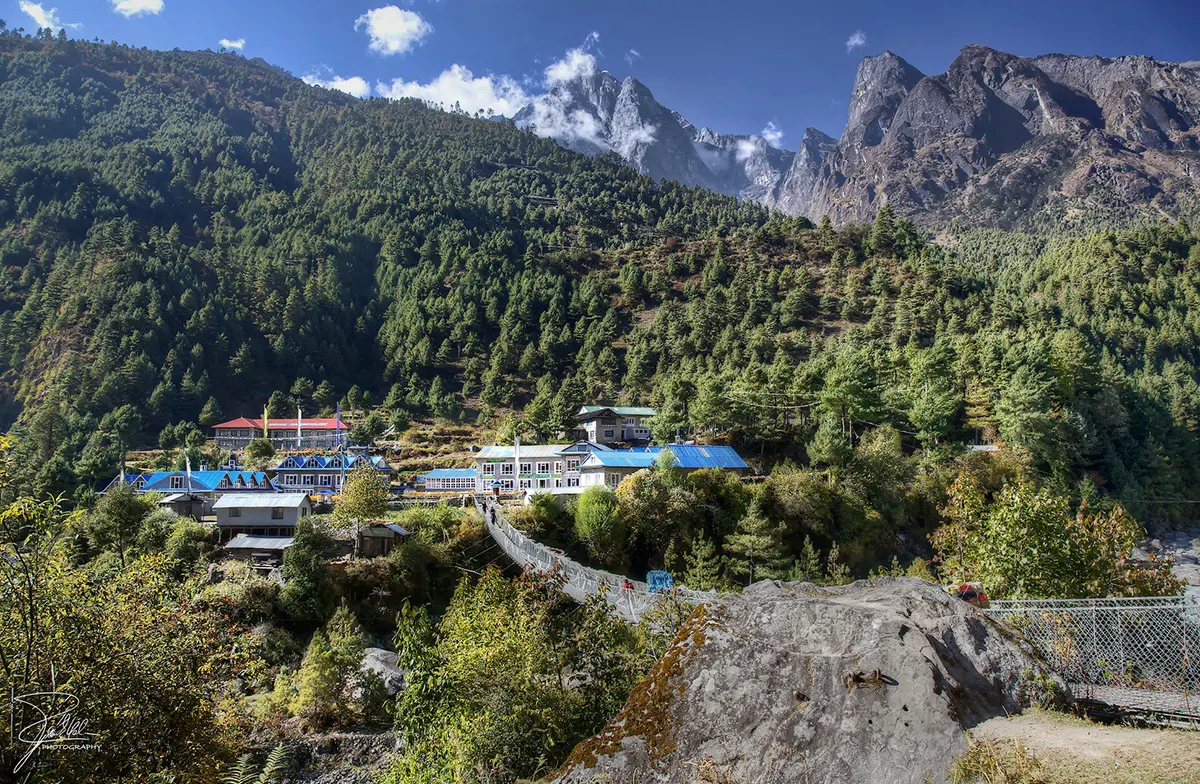
After following the path of the river, we will reach the meeting point of the Bhote Koshi and Dudh Koshi. We will cross the river junction via a high-suspension bridge to get on the path to Namche, the hotspot of the Khumbu region. The path goes through an oak forest and presents us with the first sight of Mount Everest, but it’s an exhausting ascent.
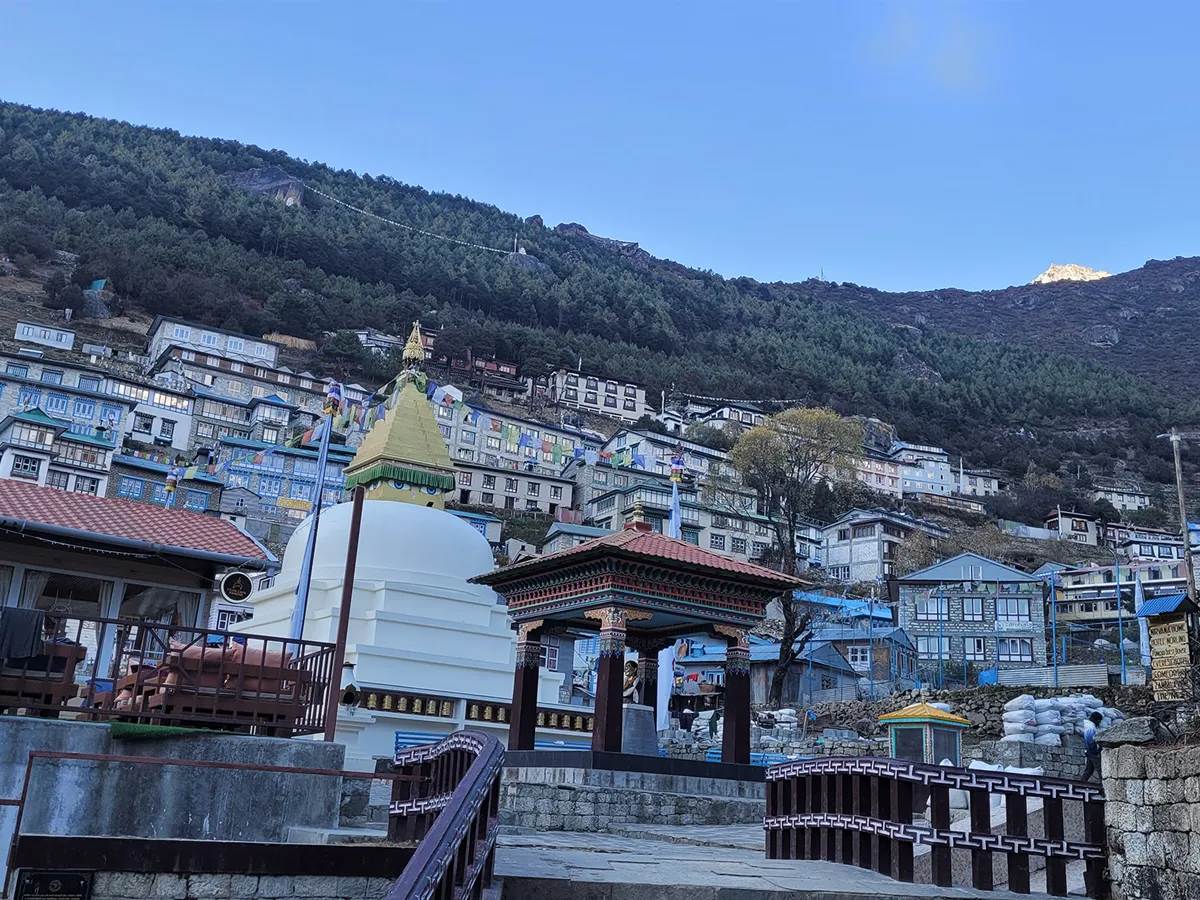
The path climbs and twists its way to Namche Bazaar, where the beauty of the vibrant community set in a lush valley is worth the journey. On the way there, you will be able to see Kongde Ri Peak. Perhaps might want to look around for a deal at the Sherpa stores. You might get a souvenir that’s worth taking back home.
Today serves as an acclimatization day following the tiring climb from Phakding to Namche. We’re going to hike over and up the ridge beyond Namche Bazaar, and following our break at the Everest View Hotel for a beautiful scene of the Everest region peaks and refreshments, we’ll descend down to the lovely town of Khumjung.
It will seem like a much easier hike today with no daypacks on our backs. In order to appropriately acclimate, we will sleep at a lower altitude in Namche after the morning hike to Everest View Hotel gaining roughly 400 meters of height.
For the rest of the day, you can visit the museums in Namche. There are a couple of museums in Namche that exhibit mountaineering history, equipment, Sherpa culture, customs, and more. The town of Namche is anything but boring.
We will leave the standard Everest trek after two nights in Namche and travel to Dole. From Namche Bazaar, we will ascend sharply to the village of Khumjung. We will have gorgeous scenes of Ama Dablam, Kantenga, and Thamserku from the village. The day’s toughest and tiring climb is through the Mong La, a magnificent location located on the base of Mt. Khumbila.
The heart of the Mong La village is an old ancient Chorten (remember to walk from the left of the Chorten). We will take a lunch break at the summit of Mong La while taking in the finest scenes of the nearby snow-covered peaks and lush thriving valleys. Along the journey, it is likely to find animals like musk deer, Himalayan thar, mountain goats, and pheasants.
Finally, we reach the village of Dole, a beautiful little settlement with some tea houses for tourists after trekking through forests, crossing rivers, and greeting waterfalls.
Today we will walk from Dole to Machhermo. An early morning gentle rise up a nice slope above Dole leads us to Lhabarma and then Luza. The trail is mostly uphill as we walk past spiny bushes to reach Lhabarma. During this part of the hike, we can see not only Thamserku and Kantega but also Cho Oyu, the sixth-highest mountain in the world.
The path goes through many summer settlements and the tiny village of Luza. The terrain will require you to maintain a low speed, so be hydrated and avoid overdoing the walk. Altitude sickness is the last thing you want to encounter in these highlands.
The Dudhkoshi valley is steep like a gorge with steep walls as you climb from Luza. Trekking from the slope over the roaring Dudhkoshi, we will encounter a few tiny villages and sandy shores before arriving at Machhermo, the final large settlement before reaching Gokyo.
The scenic river that flows through the settlement and empties into the Dudhkoshi River originates at the Phari Lapche peak. It is also the location of the very first reported spotting of Yetis by the Khumbu people. This was back in the 1970s and people in Nepal rarely had a camera with them. Most of all, it was an alleged sighting, with no strong evidence.
We will start our climb up to Gokyo village after passing through a canyon situated over the river. We will take a break in the tiny community of Pangka to take in the lovely scenes of Cholatse. We will then be in remote highland communities, and we will hike along a slope that descends away from Ngozumpa Glacier as we get closer to it.
We will have an amazing view of Cho Oyu and Kantega, both northern and southern. After we successfully reach the glacier’s nose, the trail levels off. Before arriving at Taoche Lake, which is bigger and has many birds dipping in its icy waters, we pass Longpongo, the first lake you’ll encounter on the Gokyo Lake Trek. Our route follows the Ngozumpa Glacier as we ascend the ravine, with the huge side ridge dividing us against the glacier.
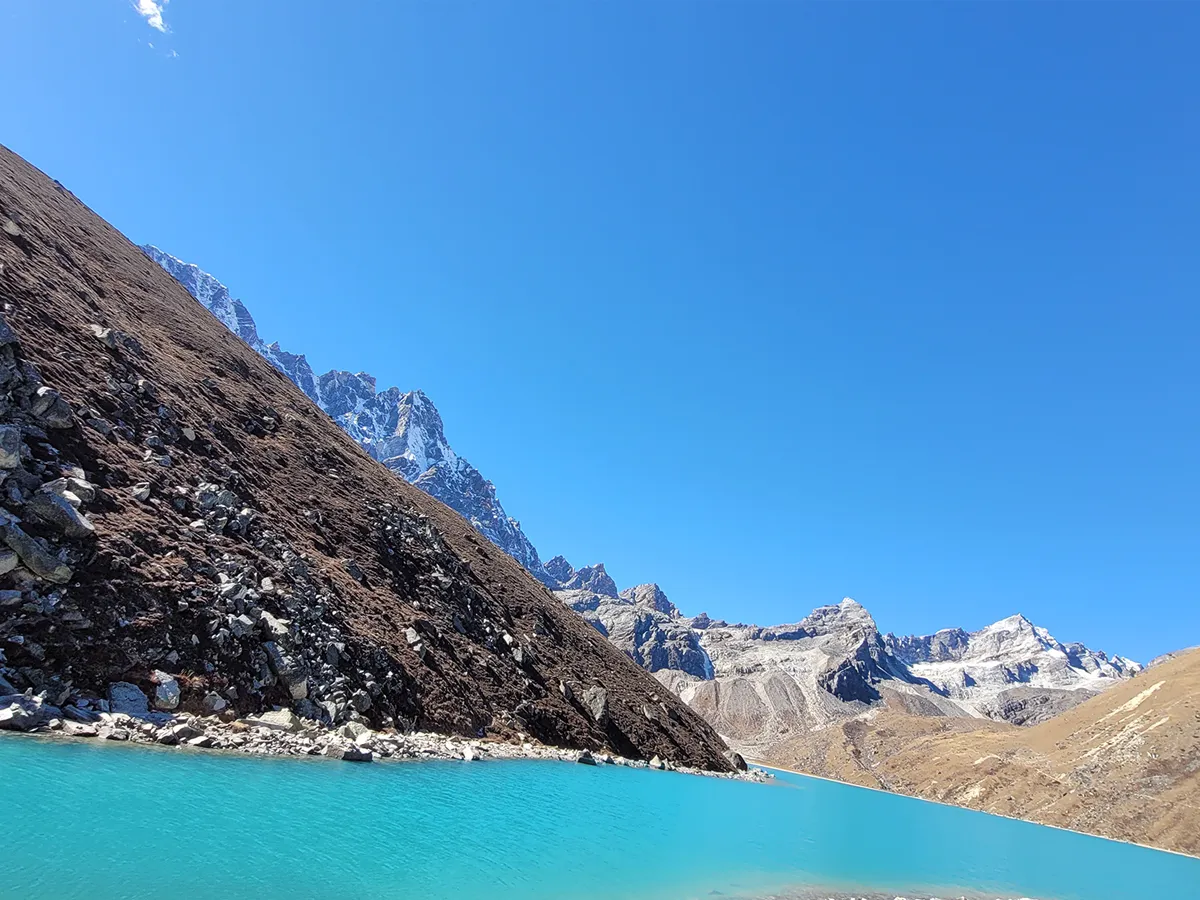
The path turns plain as it crosses the valley through the 1st lake, called Longpongo, where we have the opportunity to see the footprints of a monk engraved on a boulder. The path crosses a steel suspension bridge across a creek. You are going to be captivated by the sparkling blue-green surface of the water reflecting in the daylight when you first see the 2nd lake, Taboche Tsho.
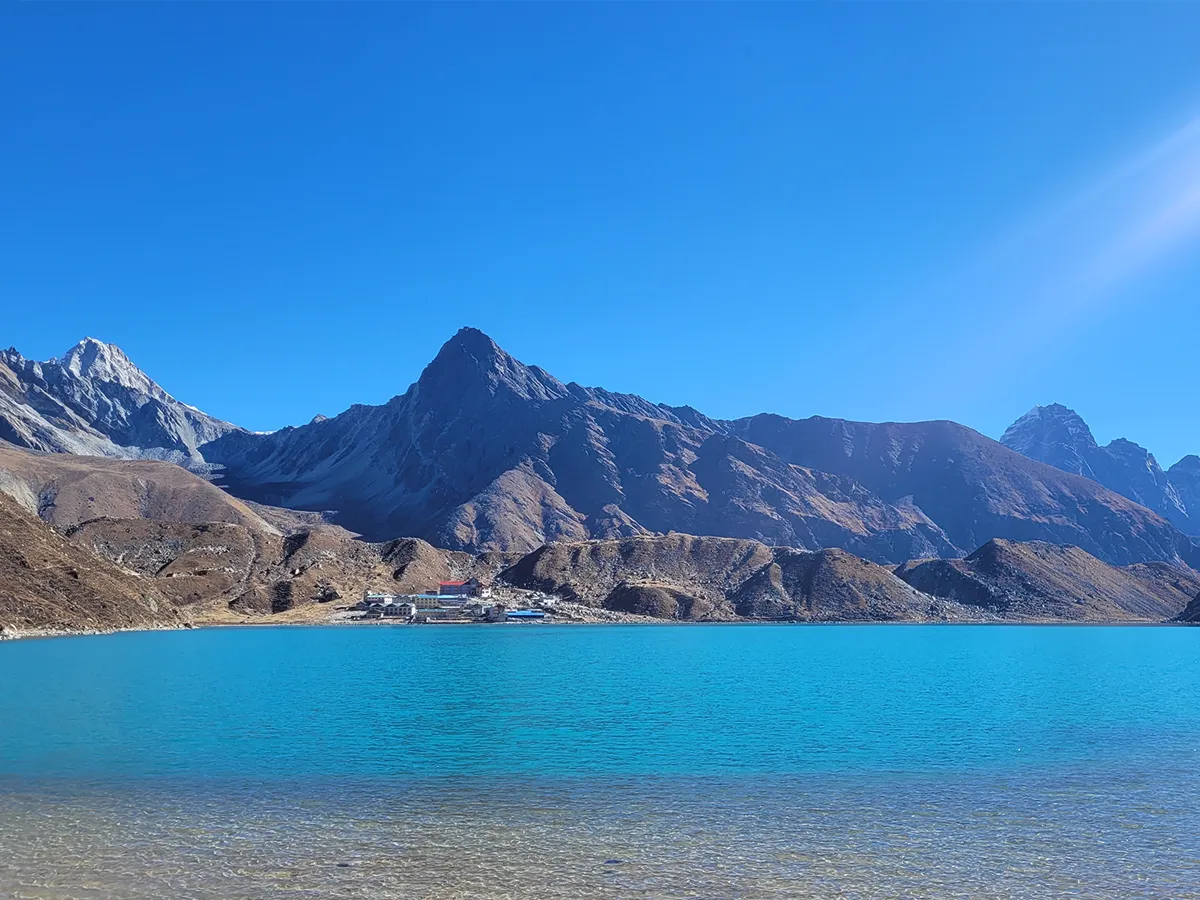
We will arrive at the third lake, Dudh Pokhari, which is a short distance from the second one, connected by a rushing stream. There’s a fantastic view of the summit of Cho-Oyu and the village of Gokyo next to the 3rd lake. Dudh Pokhari will be our next destination after lunch.
We will climb Gokyo Ri today if you did not do so the day before. The centerpiece of this Gokyo Lake Trek is obviously the Gokyo Ri. We will ascend Gokyo Ri Peak early in the morning since afternoon winds are not good for climbing peaks. Gokyo Ri is a difficult climb that takes three to four hours to get to the summit.
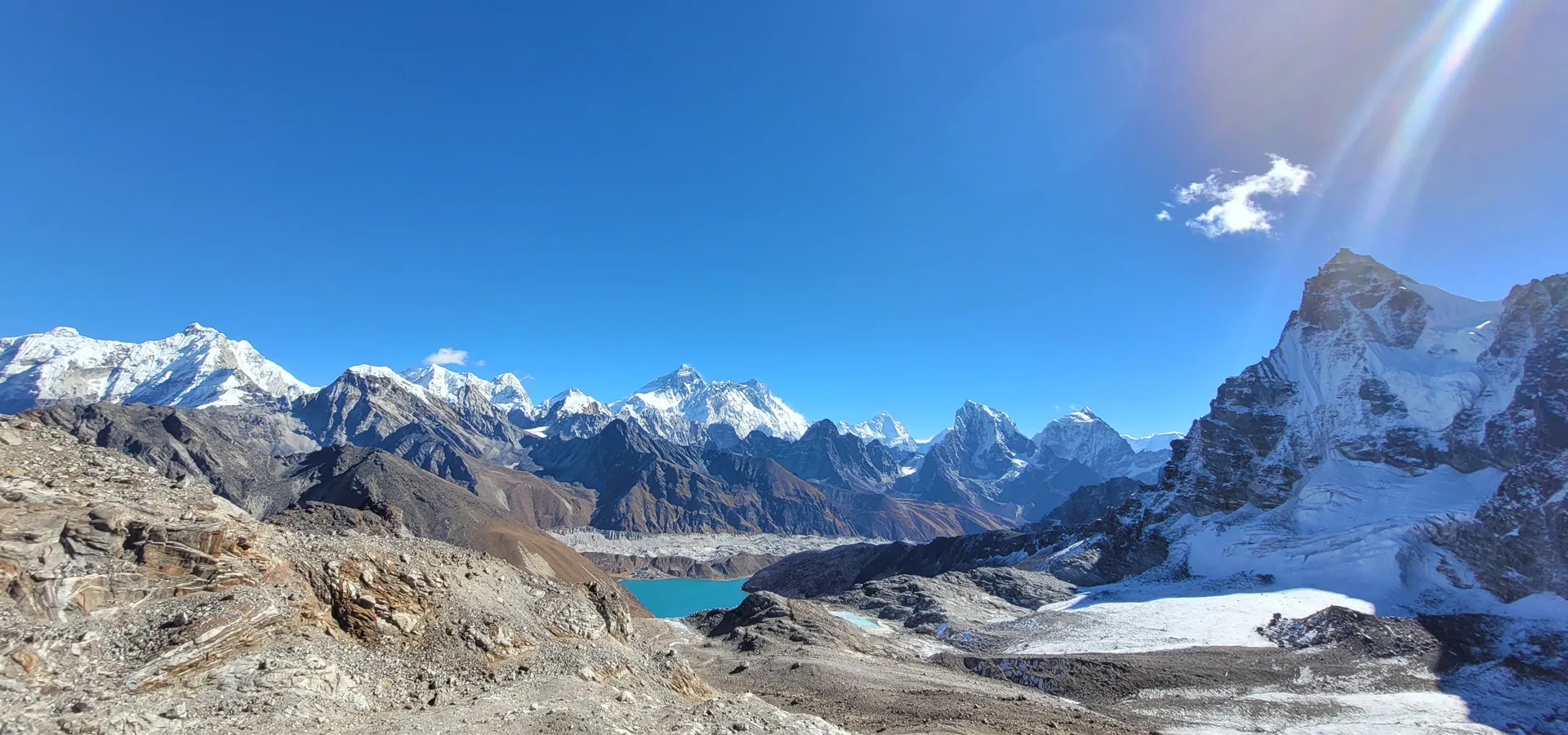
During the trek, you will see beautiful landscapes featuring the vast Nogzumpa Glacier as well as Gokyo town on the shores of the third lake, which is surrounded by Cholatse. Thamserku, Changtse, Tabsoche, Cholatse, Lhotse, Makalu, Kusum Kanguru, Pumori, Kangtega, Nuptse and Everest seem to stand on all sides.
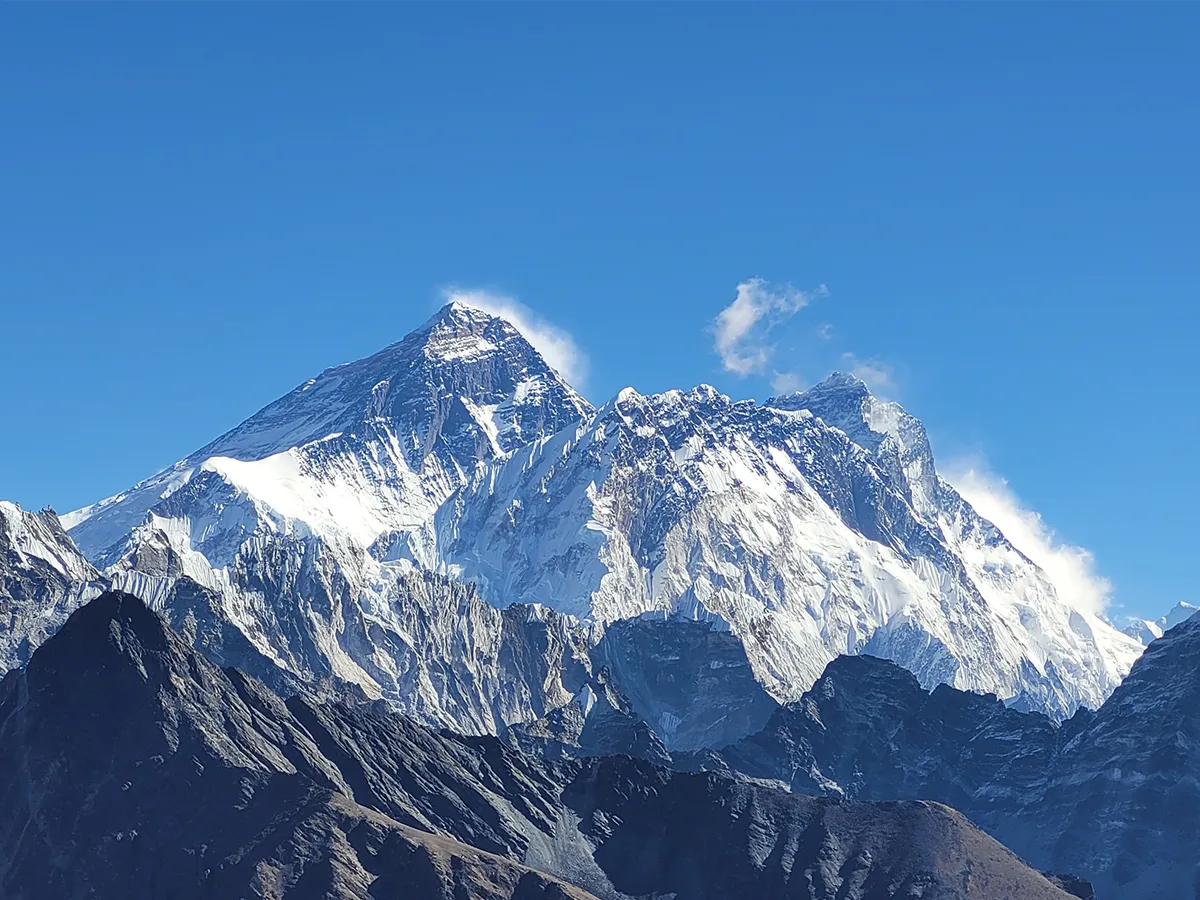
It is simply amazing to see the sunset on Mount Everest, which towers above all other nearby summits. Additionally, your trip to Gokyo Ri is going to be unforgettable. We descend to Gokyo upon being motivated by the planet’s tallest peaks. We will then head to Dole following a well-earned lunch.
The Dudh Khosi River flows quietly through the route that links Gokyo and Dole. We will be accompanied by the gentle sound of the water for the whole day trek. As we hike, we will pass settlements set away deep within the broad river area, the unforgettable views overlooking the valley are quite delightful. We are sure it will be a scene to remember. Ultimately, we will get to the tree line, a sign that the village of Dole is approaching.
Although the trek returning to Namche is longer, it is simpler because it is primarily downhill. Highlights of the day trek today include returning to the lovely Rhododendron Forest and taking in additional scenery of the valley below. We shall be strolling through a Rhododendron Forest soon, so you will know that Namche is drawing near.
Once we have returned to Namche and settled at our accommodation for the night, we’ll have time to explore the town, buy some keepsakes, and take a relaxing stroll through the town streets.
The route drops off significantly, so we will have to proceed carefully and slowly while battling the rocky ground with our wobbly knees. The path gets a bit flatter and smoother after passing the huge hanging bridge across the swift Dudhkoshi River and its branches. Now that the weather is starting to warm up, it can get rather heated.
As we continue into warmer weather today any lingering colds or sore throats that may be left over will soon disappear. Even though we are in the same way, our viewpoints differ greatly during this descent. Without fail you would longingly stare at an expanse of wide plains, oaks, and rhododendron forests as well as grand remote peaks in the distance.
While walking near the Sherpa settlements, their striking Buddhist faith and custom of hanging prayer flags will catch our attention. At Lukla, we’ll take a moment to ease our tired feet and reflect on things that happened in the last weeks. This time round at Gokyo Lake Trek would be your ultimate stay amid the mountains at high altitude.
The journey back to Kathmandu requires you to get up early in the morning. Our return trip to Kathmandu will be early in the morning since there are fewer flights in the afternoon. For the remainder of the day, you can unwind and recover at the accommodation we arranged for you. If you are not into that, we can arrange for you to see additional attractions in Kathmandu. We will also arrange a farewell dinner for you, the night’s specialty will be traditional Nepalese dishes.
Due to cloudy and windy circumstances, flights to Kathmandu are typically booked for early morning hours. Flights may be postponed for a variety of reasons, including unsuitable weather conditions.
Day 12 of the Gokyo Lake Trek is the final day. You will be returning home, taking all the sweet memories you made in the past 11 days. You are more than welcome to leave reviews about us on different digital platforms.
If our standard itinerary doesn't fully meet your needs, we are happy to tailor it to your specific preferences and requirements.
A private trip offers complete flexibility, personalized itineraries, and tailored experiences. You enjoy privacy, exclusive attention from guides, and the freedom to travel at your own pace, making the journey more intimate and customized to your preferences.
Joining a group tour offers cost savings, added safety, and the chance to meet new people. It provides expert guidance, organized logistics, and a more enriching experience through shared insights and camaraderie.
The Gokyo Lake Trek starts at Kathmandu. As you land at the international airport in Kathmandu, you will be directed to the immigration booth to fill out your tourist visa application form. Once all is set and done, you will be free to leave the airport and our representative will welcome you to the amazing nation of Nepal. If you have any questions about the trek or about Nepal in general, feel free to ask our rep.
The next day, you will be flying to the starting point of the trek, Lukla, where you will get the first glimpse of the peaks of the Khumbu region. During your flight to Lukla, you will be able to enjoy a scenic panoramic view of the entire valley and more. Throughout the trek, you will visit and stay in authentic remote highland villages including Dole, Macchermo, Phakding, Namche Bazaar, etc.
The Gokyo Lake Trek is graded as a moderate trek, given its few difficult ascents and the majority of easy walks. For the most part, you will be walking scenic and plain trails while you will have to ascend some inclined sections, do a peak climbing session, and cross multiple suspension bridges. Elevation gain is also an important factor when considering the difficulty of any trek.
In this Gokyo Lake Trek, you will gain an average of 500 meters of elevation per day. But on the day of climbing the Gokyo Ri peak, you will gain about 700 meters of altitude. However, since you will get back down hours later on the same day, you are unlikely to feel the effects of this elevation gain. On a scale of 10, we would rate this trek a solid 7.
The best season for this Gokyo Lake Trek is the season of autumn. During the months of September, October, and November, the average temp ranges from 14°C to 20 °C which is very mild or might be cold to those who come from tropical nations. The average temp drops by a couple of degrees as mid-November kicks in.
This season is considered the best given its clear skies, lack of rainfall (very minimal), and the fact that it is the festive season in Nepal. During your stay in cities, you can enjoy various festivals played out in the streets of Kathmandu and the greatest Nepalese festival of Dashain also falls in this season.
The season of spring is another great choice for the Gokyo Lake Trek as it offers the same qualities but you are more likely to encounter rain. Spring is also the time for snowfall in most parts of the highlands in Nepal. In the months of March, April, and May, you will experience an average temp of 17°C to 25°C.
A beginner can join a moderate trekking destination but since this Gokyo Lake Trek features peak climbing (Gokyo Ri), it is not recommended for beginners to tag along. Having at least a couple of trekking experiences beforehand is greatly beneficial as you will be familiar with what’s coming and also be more confident. Beginners can do this trek leaving out the peak climbing part, but they have to be physically fit enough to trek for 5 to 6 hours per day.
There are no potentially hazardous regions or risky situations on the Gokyo Lake trek. The one scenario that could go wrong for trekkers is altitude sickness, and that is quite personal. While certain individuals suffer from no issues at all, some begin to feel “ill” as soon as they reach 3000 meters.
We can only advise you to take it extremely slowly, especially over 4000 meters. Eat healthily, keep yourself well hydrated at all times, and do not sleep at higher altitudes than your daily destinations (hike high sleep low). The locals think that eating garlic soup can help avoid altitude sickness, you can try it yourself to find out.
You can drop to lower levels of elevation and rest for a night if you begin to experience any of the signs of altitude sickness, which can vary greatly from person to person and include headaches, nausea, and disorientation. If things improve, you can carry on. Many people suffer from altitude sickness which is why having a couple of days as contingency days is very useful in the highlands.
For breakfast, you are offered toast, eggs (fried, boiled, or poached), local potatoes, tea/coffee, muesli, porridge, etc. There are not many options since getting food items to the remote villages is very hard, even if they manage to get different food in the remote areas, the food will spoil soon as they do not have refrigeration. So, everything you have there is freshly made and locally sourced.
For lunch, you have a couple more options compared to breakfast. You can choose from the traditional Nepalese lunch, noodles, pasta, macaroni, momo, spaghetti, thukpa, sandwich, pizza, and more. The traditional Nepalese lunch consists of rice, lentils, veggies/meat, chutney, and a little salad on the side. But we recommend you stick to a veg diet for the entire duration of the trek as most of the eateries there do not have refrigeration.
During your Gokyo Lake Trek, you will be staying in local tea houses in the villages. These tea houses offer basic bedrooms with two single beds in each room. These bedrooms are supposed to be rented on a twin-sharing basis, meaning two persons have to share a single bedroom. If you are one of those person who like sleeping alone, you might have to get used to sleeping with a friend since single-person rooms are not a thing in these regions.
While you are in Kathmandu, you will be staying at a 3-star hotel with breakfast provided. The rest of the meals are on you while in Kathmandu. While you are trekking in the highlands, we will provide breakfast, lunch, and dinner. Any kind of beverage is not a part of the Gokyo Lake Trek package, including water.
For this Gokyo Lake Trek, you will have to travel to the airport to catch a flight to Lukla. At the end of the trek, you will be going back to Kathmandu via a flight from Lukla. All of this transportation will be covered by the trek package along with pick up and drop off at the international airport in Kathmandu.
You are legally required to have a Sagarmatha National Park Entry Permit and a Khumbu Pasang Lhamu Rural Municipality Permit. The national park permit will cost you NRs. 3000, if you are from one of the SAARC nations, you only have to pay 50% of the cost of NRs. 1500. Meanwhile, the Pasang Lhamu permit is priced at NRs. 2000 for every international visitor. All of these permit fees will be covered by your Gokyo Lake Trek package.
Since this trek is graded as moderate, you should prepare for this trek about 5 to 6 weeks before the scheduled start of the trip. For physical preparation, the best thing to do is to hike hills since it is the closest thing to trekking in the mountains of Nepal. If you are unable to do so, you can simulate the same experience using the ladder machine at your local gym. The important thing is to train your cardio and endurance.
The Gokyo Lake Trek requires you to ascend and descend the dirt trails of the Himalayas which is quite tiring, so having the right stamina to get through it is important. During your trek, you should be able to focus on the views rather than worrying about gathering energy to take your next step. For this, you have to be physically fit with an above-average physicality.
Your main goal of training for this Gokyo Lake Trek should be to be able to walk 5-6 hours per day with ease.
The Khumbu and Gokyo regions are one of the most developed trekking destinations of Nepal as they are one of the most popular destinations. You will not run into any major issues with charging your electricals but you might face a power outage. Power outages usually last for about an hour or 30 minutes. You might also be charged a couple of dollars as a service fee for letting you charge your devices.
As for the internet, you should not expect any cutting-edge WiFi connections. The internet connections here are far worse in comparison to what you will get in the cities. Usage of the internet is also subject to a couple of dollars.
Your extra expenses include visa fees, emergency evacuation services, any kind of beverages, internet services, gadget charging, laundry, and other extra services in tea houses, personal trekking gear, tips for the crew, and anything that is not mentioned as a part of the Gokyo Lake Trek package.
The Gokyo Lake Trek is about 110 kilometers long and lasts for 12 days as per the standard itinerary. We offer you the flexibility of getting to shorten or extend your trek. If you do not have enough time, you can also opt not to climb the Gokyo Ri trek and just enjoy the scenes of the Gokyo Lake instead.
The Gokyo Lake Trek is not an easy trek at all, you have to trek many ups and downs sections and climb a peak as well. This trek is considered a moderately difficult trek.
The Gokyo Lake trek costs USD _____ per person. This cost will cover all your accommodation, breakfast, lunch, and dinner during your trekking days, daily wages for porters and guides, farewell dinner, duffle bags, sleeping bags, transportation costs, and more.
Yes, you will be able to see the highest peak in the world, Mt. Everest during the Gokyo Lake Trek.


