


20 Days

Difficult

5,535m

Nepal

2-16

Hotel

Plane,Jeep

B, L, D
Explore more facts about the trip
US$ 2099
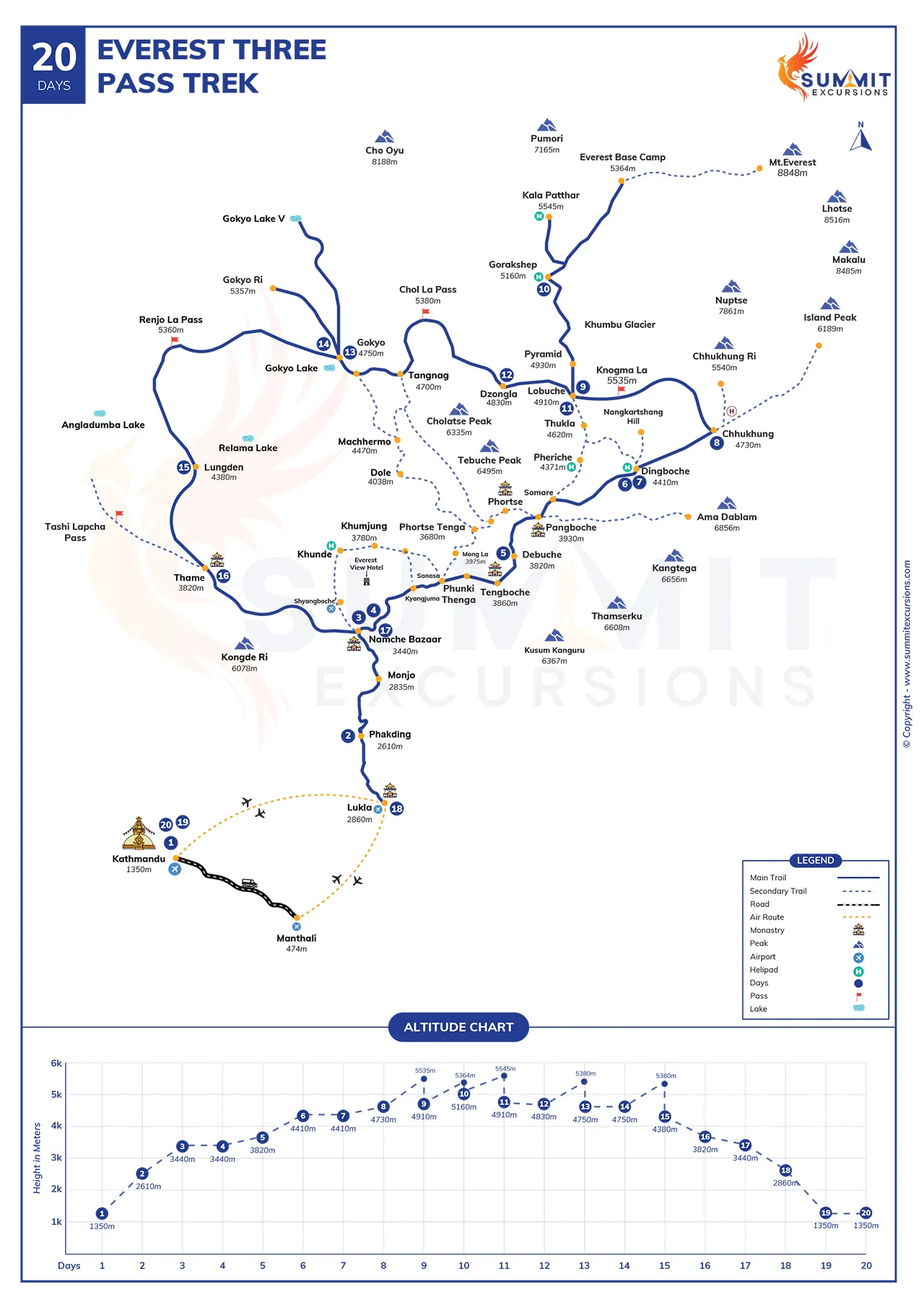
The Everest 3 Pass Trek is a challenging trek set in the Everest highlands, offering some of the best views you can see in the Khumbu region. Each of the passes we will cross offers a unique perspective of the Khumbu region. The Renjo La Pass (5,345 m), Kong Ma La Pass (5,545 m), and Cho La Pass (5,420 m) and are the three passes in this itinerary.
The Everest region is famous for being the home to the highest point on Earth but the Everest Base Camp trek itself is nothing compared to the Everest 3 Pass Trek. The three-pass trek is more challenging, and exciting, and requires more days. All of these features make it a worthy trek for experienced trekkers.
Throughout the trek, you will be staying at remote Sherpa villages, experiencing their daily lives, their customs, and tasting the local food. Dishes like Riki Kur, Tsampa, Thukpa, Tingmo, Shyakpa, Rildok, Mo: Mo, and others are staple dishes in the highlands of the Khumbu region. During your stay in the mountains, you can try their local delicacies along with contemporary dishes like pasta, sandwiches, pizza, etc.
You can also try their locally brewed alcohol which tastes nothing like you have ever had. But do not drink too much, we have a trek to finish. You can drink the local alcohol at the end of the trek as a celebratory drink.
The Everest 3 Pass Trek is definitely a challenging journey that needs a lot of preparation. If you are out of shape, we recommend you get in shape, work out, eat healthy, and be physically fit before the start of the trek. You will be trekking 5 to 6 hours on average, per day, and climb 3 different passes. So, you need to be in your top form. Let’s get to know all about this amazing trek.
The 1st day of the Everest 3 Pass Trek has you arrive at the international airport in Kathmandu. There you will get your tourist visa after a short formal procedure that requires you to fill up a visa application form and have a couple of documents. These documents include proof of accommodation, 2 passport-sized photos, a valid passport, and return tickets.
After you have filled in your visa application form, you should pay the visa fee at the bank counter, and submit all the documents at the immigration booth. Only then will you get your tourist visa approved.
On the 2nd day of the Everest 3 Pass Trek, we will travel to the gateway to the Everest region, Lukla. This tourist hub is the starting point of the Everest 3 Pass Trek and every trekker that is on any of the Everest region trek visits this village. We will take a short 40-minute light to Lukla but you can also opt for a trek from Jiri to Lukla.
This alternative starting point of the Everest 3 Pass Trek is a beautiful start to a magnificent trek as you will have the trail to yourself. Most people choose to fly to Lukla as they do not want to spend an additional 2 to 3 days trekking to get to the starting point of the trek. Since the route from Jiri to Lukla is not frequently traveled by trekkers, you will rarely meet any fellow trekkers during your trek.
Passing through authentic and charming Sherpa villages, you will reach the village of Lukla. This alternate start will add 3 more days to your standard Everest 3 Pass Trek itinerary.
Note: Flights connecting Kathmandu and Lukla are often postponed or canceled because of the unpredictable weather conditions of the highland of Lukla. To avoid wasting your days in Kathmandu, waiting for the weather to clear, you can get on a shared helicopter ride which will cost you USD 450 per person.
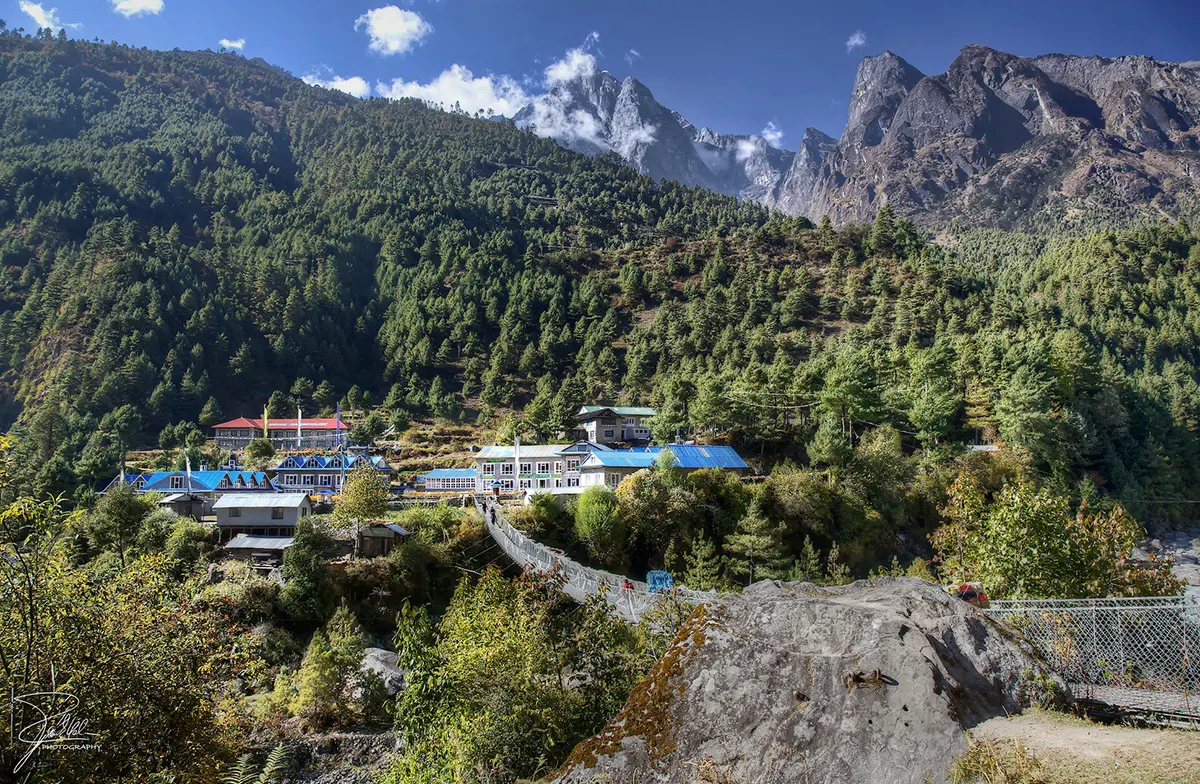
The day gets off to a good start. After stopping at the checkpost to obtain the Sagarmatha National Park permits for everyone in the group, we can continue strolling along the river. This portion of the hike for today is really beautiful. A stunning scene featuring two hanging bridges is the highlight of the day. Ultimately, you’ll pass over the taller bridge. It’s all an ascending path from this viewpoint until we reach the charming Namche.
After climbing for around 45 minutes, we’ll reach a public restroom with a view of Mount Everest. Additionally, there is a tap here midway up the ascending portion where you may fill up your water bottles. We will ultimately reach another checkpoint as we keep going uphill. From there, Namche Bazaar is only 20 minutes away.
A great Everest 3 Pass Trek requires sufficient acclimatization, and since Namche Bazaar is 3440 meters above sea level, trekkers need to stay a second day there to become used to the elevation. In addition, it’s the last point of modernity with pubs, cafes, theaters, ATMs, etc. From this point forward, rates for every commodity and service increase with the increment in altitude, and the availability of types of services significantly decreases.
For our acclimatization hike, we will climb up to the Everest View Hotel. This is the most popular acclimatization hike for trekkers at Namche Bazaar. If the day is cloudy, it’s best not to do this hike, we will instead visit the different museums around the village and the Tenzing Norgay Statue.
This is our first proper experience of Nepal’s highland plains; we will only make a small elevation gain, ascending more than 1,000 meters and dropping more than 700 meters. It’s going to be a lovely day for taking a walk amid the oak and rhododendron forests, which are interspersed with steep slopes.
Crossing small monasteries and Chortens decorated with pictures of such notable Tibetan leaders as the Dalai Lama of Tibet gives us an impression that we are truly in Tibet.
About five centuries ago, the Sherpa ethnic group escaped oppression in Tibet arriving in Nepal’s Himalayas. They thrived well here since the living conditions resembled those back home. We will be walking along an ancient trade route, it is obvious that the locals are quite hospitable and friendly.
We go slowly and deliberately, walking at a speed that fits with the characteristics of the landscape. As we climb and descend, the pace changes, but it’s always beneficial to trek slow. The trek develops a quiet atmosphere as we regularly cross the Chortens to the left.
Buddhism always tells people to follow the clockwise motion when circling a religious site, which is why you should pass the stupas from the left even though you are not going to go around it. We reach Tengboche town and the monastery sharing the same name, the summit of the day. Following a fire accident in 1989, Edmund Hillary renovated the monastery, which is impressively preserved.
From Tengboche, we will walk for about an hour (6.5 kilometers) to reach Deboche.
Today’s day hike proceeds through lovely greenery, with frequent sights of Mount Everest serving as a constant reminder of our remote trekking aim. After lunchtime, it is a bit tough because we will have gained an appropriate attitude which hosts a bare landscape and the view is not exactly motivating. It can get a little cold during gloomy days.
If weather permits, in the early afternoon you can expect a glorious hike with marvelous views and visit the Pangboche Gompa which houses the region’s oldest monastery of about three hundred years old built up in there. In Nepal, this monastery happens to be the oldest one.
As we climb up Debuche, the trees abruptly stop accompanying the ridges and hills. Unlike previous days where there were long ascents and descents, this hike is just all uphill.
Sitting at an altitude of 4110 meters above sea level, the village of Dingboche is one of the most authentic, charming, and remote Sherpa villages of the Khumbu region. For your acclimatization day, you can choose to wake up early in the morning to enjoy the one-of-a-kind sunrise view from the top of a nearby hill.
A small stupa accompanies the lonely hilltop from where you will get to enjoy a scenic heaven as the first sunrays hit the white peaks in the distance, radiating the whole landscape in an instant.
If you are not a morning person, you can simply wake up around 7 or 8 in the morning and go for an acclimatization hike to Nagarjuna Peak. This 300-meter climb will take around 4 hours in total to ascend and descend.
We will begin our day trek with a leisurely and filling breakfast. We’re going to walk in the direction of Chukhung, a tiny settlement north of our current position. A glance at the elevation map alone may give the impression that the hike is simple, but the shortage of oxygen results in it becoming increasingly difficult.
As we go around the wide terrain, we can spot a few yaks munching as we take in the scenery. Yaks are amazing animals, however their enormous horns and lengthy hair can occasionally give them a threatening appearance. But there are no accounts of Yak attacking trekkers out of the blue or making a person injured in any circumstance.
We are going to see the Kong Ma La Pass today. We will set off at 8:00 AM after breakfast, full of energy to start the day’s trek and a little bit of concern regarding the environmental settings at 5,500 meters of altitude. Ama Dablam remains to be alluring even on rainy days although it appears less attractive sometimes.
It is imposing; the incline up is consistent and leisurely when walking along a path. Before proceeding up for some more distance we will take a pause opposite of an icefall for food and drinks. Re-energized, we carry our daypacks once more and go for the uphill stretch; the hardest part so far.
The steep section leads us to a plateau where solo trekkers often get lost or go around in circles. We will then traverse the Kong Ma Glacier and eventually reach the Kong Ma La Pass. As you reach the top of the pass, you will definitely feel a sense of accomplishment.
The snow can be quite slippery, so we recommend you put on your micro spikes during the descent. We will be able to see our destination from the pass and the massive Khumbu Glacier separates us from Lobuche.
Despite just being 12 kilometers long and up to one km broad in some areas, the Khumbu Glacier leaves a lasting impression on hikers. This stretch has a few credible trail markers, although in bad conditions they are difficult to find.
There are glacial lakes and shimmering white or blue glacier blocks sometimes visible through the huge and tiny stones covering this portion. Following an hour of trek, we will traverse the Khumbu by navigating around huge rocks and arrive at the tip of the glacier shortly before Lobuche.

After having breakfast you will walk across Khumbu Glacier’s moraine. Other than the northern face of Everest, one can see Nuptse, Pumori, Khumbutse, Mahalangur and Lingtern just in front of your eyes. After a short climb to Thangma Riju, from where you may take in the broad scene of the landscape, you’ll hike up a difficult path to Changri Glacier to reach its summit.
Upon arriving at Gorak Shep, the nearby peaks will encircle you. Before moving on in the direction of EBC, we will stop and admire the scenery for a while. After arriving at the base of the highest peak on the planet, we will take some pictures, tour around the base camp, and then make our way to Gorak Shep. We will spend the night in Gorakshep.
From Groakshep, Kala Patthar is just 2 hours away but the trail can be quite tiring as it is an uphill section. The trail is only 2 kilometers long but since it’s an uphill ascend, it will take some time to reach the top. Moreover, it becomes even more tiresome because we are over five thousand meters high. When we go up the mountains less oxygen is found in the air which makes us tired fast since we have to breathe more times before getting enough oxygen in our bloodstream.
At about seven o’clock in the morning after having eaten enough and energizing breakfast, we shall start our day’s trek. When we get to the viewpoint there will be a complete panoramic view of all the Everest region and its great peaks around it.
After taking our sweet time to admire the scene, we will get back down to Gorakshep where we will have our breakfast, gather our belongings, and get on the way to Lobuche. From Gorakshep, Lobuche is only 4 kilometers away which will take around two hours to reach.
From Lobuche, we will go on with the traditional Everest Base Camp approach until it branches at the higher part of Thokla Pass. Taking a right turn, we will be walking along the southern slope of Awi Peak. The trail that is evidently marked goes around to the west and has a view of Taboche, Cholatse, and Arakam Tse.
Chola Tsho Lake lies below here whilst the path gets little up and down before descending very far towards Dzongla. The village of Dzongla can be a bit underwhelming as it is not as lively as the other villages.
We’re going to get up at 7:00 AM, get our things packed, and have breakfast by 7:30 AM. We will also be packing our lunch as there are no eateries on the way. After leaving Dzongla, the path travels northwest through a rather level terrain and arrives at a location where micro spikes are required. Even though the terrain is quite easy, some hikers may find it difficult owing to the altitude gain.
Having crossed a small river, the trail leads steeply up an incline dotted with boulders into the glacier under Cho La Pass. So far, this path has not varied much from what we met in our previous ten days’ journey. In about 3 hours’ time we will ascend through Cho La pass and enter Gokyo area.
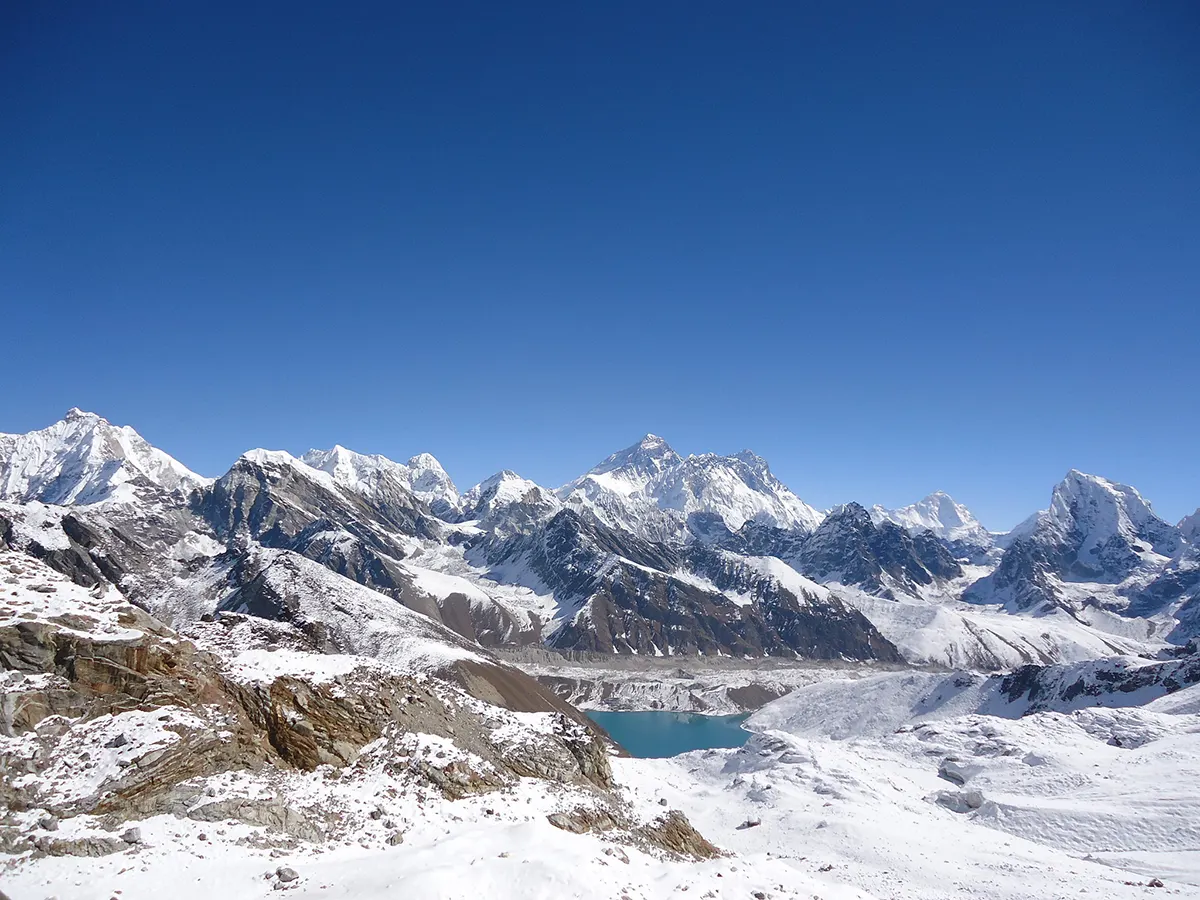
Gokyo, one of the most aesthetic settlements in the Khumbu region, is located on the eastern shore of a stunning lake with a glowing bluish color. From a distance, the path leading to the summit of Gokyo Ri, which lies on the northern edge of Gokyo Lake, appears sharp and rigid. We will climb downward toward the Gokyo Ri after snapping a couple of shots over boulders with the fantastic scenery in the far distance.
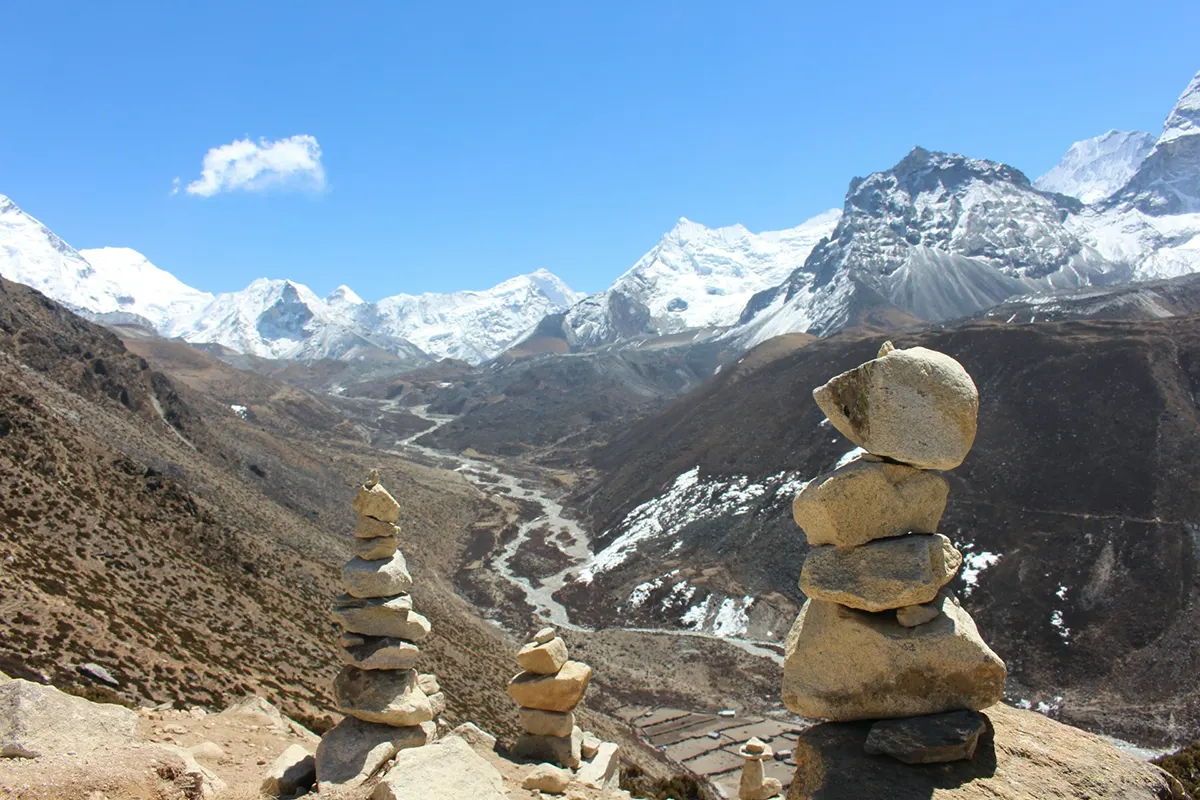
The path zigzags up several alternative paths passing cairns before climbing sharply over dry soil and then a rough path. There’s a path that goes all the way to the peak of Gokyo Ri, where prayer flags sway in the gusts.
Scenes of Lhotse, Taboche, Cholatse, Everest, Makalu, and Cho Oyo, in addition to the holy lakes of Gokyo extending south of the summit, are apparent from the summit. The summit of the Gokyo Ri is the first viewpoint that lets you see the difference between the tallest peak, Mt. Everest, and the other peaks in the region.
The following day, we will traverse Renjo Pass after exploring the beautiful Gokyo Lakes and climbing Gokyo Ri. Known as the easiest Himalayan crossing with the most panoramic scenes of the peaks, this pass ranks as one of the most well-known passes in Nepal.
The entire trip from Gokyo village to Lungden is 11 km long, including a 650-meter climb to Renjo La and an almost 1100-meter descent to Lungden. Although there are some uphill parts, the path is generally easy. Compared to Gokyo Ri, the climb up is visually pleasing and easier, however it takes longer.
Following the Bhote Khosi downhill, we will begin our descent to Thame energized by our morning breakfast. We will cover a total distance of almost 10 kilometers from Lungden to Thame. If you are in the mood to visit the Thame Gompa, we can do a slight detour but most trekkers prefer to view it from a distance since they are tired from weeks of trekking in the Himalayas.
Thame is yet another quiet village where you are unlikely to see many trekkers staying. This makes it the perfect place for resting.
Since we are leaving for Namche Bazaar today, we will be really eager to get started. Having hiked across the remote Himalayas for two weeks, this small town feels like heaven. The journey to Namche is largely uphill and downhill sections, but since there’s more concentration of oxygen in the air at lower altitudes, it will not feel too taxing. But, relative to what you’re acclimated to, it feels very warm, so dress accordingly today.
From Namche, we will travel about 26 kilometers to reach Lukla. It’s the longest distance covered in this Everest 3 Pass Trek but since we are descending and our bodies have adjusted to the altitude, this should not be much of an issue. However, this does not mean that the downhill trek will be easy.
Since Lukla is the final stop of the Everest 3 Pass Trek, we will all be motivated to get there and eventually to Kathmandu.
The next day, we will get to the vibrant and bustling city of Kathmandu. Our flight to Kathmandu will leave early in the morning to avoid the afternoon winds and clouds. Once we reach Kathmandu, you will check in at a 3-star hotel to stay for the night. Based on your preferred timing, we will arrange a farewell dinner for the night. Tonight’s specialty will be traditional Nepalese and Newari dinners.
Day 20 of the Everest 3 Pass Trek ends the beautiful journey. We hope that you have made memories that will last a lifetime and we are also open to reviews, recommendations, and feedback.
If our standard itinerary doesn't fully meet your needs, we are happy to tailor it to your specific preferences and requirements.
A private trip offers complete flexibility, personalized itineraries, and tailored experiences. You enjoy privacy, exclusive attention from guides, and the freedom to travel at your own pace, making the journey more intimate and customized to your preferences.
Joining a group tour offers cost savings, added safety, and the chance to meet new people. It provides expert guidance, organized logistics, and a more enriching experience through shared insights and camaraderie.
The Everest 3 Pass Trek starts from Lukla but before that, you will arrive at the international airport in Kathmandu where you will meet one of our representatives. He will have a car ready for you to take you to a 3-star hotel for your night stay. The next day, we will transport you to the airport once again to fly you out to Lukla, the entry point of the Khumbu region.
After your flight lands at Lukla, you will gather your belongings and set on the trek to Phakding. On this day, you will not trek a lot as you have to get used to the climate first. Following that, we will get to Namche, Dingboche, Chhukung, Lobuche, and a couple more Sherpa villages throughout the trek.
The Everest 3 Pass Trek is considered a challenging trek as you have to cross three different Himalayan passes. The trek itself is nothing abnormally tough but the fact that you have to climb three passes makes it a challenging journey. The decreased percentage of oxygen in the atmosphere also makes it a bit tough for trekkers to hike the ascending and descending trails. Out of 10, our expert guides rate this Everest 3 Pass Trek a hard 8.
The best season for the Everest 3 Pass Trek is autumn. During the months of September, October, and November, you will get to experience the best weather conditions and temp for trekking in the highlands of Nepal. You can also choose to do this trek in spring since it has features similar to those of autumn. But the weather is more prone to rain and snow in this season.
The maximum elevation this Everest 3 Pass Trek takes you to is 5,535 meters at Kong Ma La Pass. This level of altitude is prone to altitude sickness but we will not be spending much time at such a high altitude so you are unlikely to suffer from severe altitude sickness.
Altitude sickness starts from the altitude of 3500 meters but it is not that serious at such a level. It gets serious after you cross the 5000-meter mark. Since our Everest 3 Pass Trek is rarely set above 5000 meters above sea level, you are safe from altitude sickness. But you might experience slight dizziness, headache, or other altitude sickness symptoms after crossing 3500 meters altitude.
To combat this, we have included 2 acclimatization days in this itinerary to better allow trekkers to get used to the change in surroundings and elevation.
The Khumbu region is one of the most developed trekking destinations of Nepal allowing you to choose from a range of accommodations at lower altitudes but accommodations at higher regions are limited to tea houses and small lodges. These accommodations are basic, they provide twin-sharing bedrooms, meaning you have to share your bedroom with one of your fellow travelers. Sometimes you have 3 beds in the room which means 3 people are supposed to share the room.
When it comes to food, you will get to taste a variety of local Sherpa dishes and a number of modern foods such as sandwiches, pasta, macaroni, pancakes, etc. You should try the local Sherpa dishes as much as possible because you are not going to get authentic Sherpa food anywhere else. Any kind of drinks are to be paid out of your own pocket, they are not a part of the Everest 3 Pass Trek package.
When it comes to any Everest region trek, trekkers have to get to Lukla to start their trek. There are two ways to get to Lukla, a 45-minute scenic flight or a 3-day trek from Jiri. For this Everest 3 Pass Trek, we will take a flight instead. Besides that, we will make sure to pick you up from the airport at the start of the trek, and at the end of the trek we will drop you off as well. All of the transportation required by the standard itinerary will be covered by the Everest 3 Pass Trek package.
For this Everest 3 Pass Trek, you are legally required to have the Sagarmatha National Park Permit and Khumbu Pasang Lhamu Rural Municipality Permit. Both of these permits are covered by the trek package.
To prepare for this trek, you have to work on your stamina and lower body. Muscles are not needed for this trek so while you are training for the trek, do not focus on lifting weights, instead focus on walking for hours on end. If you are overweight, we recommend you trim down a little before the start of the trek, we do not want you to struggle all the way.
For the most part of the trek, you will be able to charge your gadgets without any issues but while staying at remote villages like Dzongla, you might face frequent power outages. But they also rely on solar power to illuminate their houses, so you won’t have to stay in darkness during power outages. Besides that, the internet is not very reliable in the highlands given that there are fewer internet towers in the region.
You can be charged a couple of dollars for both charging and internet.
Expenses like international flight tickets, travel insurance, visa fees, helicopter for emergency evacuation, an extra day in Kathmandu or Lukla in case of flight getting canceled and postponed due to bad weather, any kind of beverages, extra services at tea houses like gadget charging, laundry, and internet, any kind of beverages, tips for the porters and guide, personal trekking equipment, and anything not mentioned as inclusive to the Everest 3 Pass Trek package.
No, this Everest 3 Pass Trek is a challenging trek, not fit for beginners and first-timers alike. This trek is meant for experienced trekkers under the guidance of a licensed guide.
The Everest 3 Pass Trek takes about 20 days (standard itinerary) wherein you will cover a total distance of about 165 kilometers.
The Everest 3 Pass Trek can be done solo and without a guide as well, but you have to have immaculate planning to pull this off. You might wander off in the wrong direction if you are not careful enough and losing time and energy in the remote Himlayas is not a good thing.
To train for the Everest 3 Pass Trek, you have to focus on leg workouts, making sure that you have enough stamina to walk 5 to 6 hours per day.


